

Digital SAT Reading and Writing Question Types: All Four Domains Explained
- truptisharma
- 2 hours ago
- 8 min read

The Digital SAT Reading and Writing section draws every question from one of four content domains: Information and Ideas, Craft and Structure, Expression of Ideas, and Standard English Conventions. Information and Ideas asks what the text says and what the evidence supports. Craft and Structure asks what words mean and what sentences do. Expression of Ideas asks what achieves a stated goal. Standard English Conventions asks what's grammatical. Every question you meet belongs to exactly one of them.
The SAT is a standardised college admissions test scored from 400 to 1600, and its Reading and Writing section runs 54 questions in 64 minutes across two modules of 27. The four domains are interleaved rather than blocked, so you'll switch between them constantly, without warning. Knowing which domain a question belongs to, within a second of reading the prompt, is what lets you apply the right method instead of reading everything the same way. The Digital SAT format covers the section structure in full.
This page is the map. Each domain gets a short description of what it actually asks and where students lose points, with a link to the guide that covers it in depth.
What Question Types Are on the Digital SAT Reading and Writing Section?

Here's the whole section on one screen:
Domain | Question types inside it | The question is really asking |
Information and Ideas | Central ideas and details, command of evidence, inferences | What does the text say, and what does the evidence support |
Craft and Structure | Words in context, text structure and purpose, cross-text connections | What does this word mean here, and what is this sentence doing |
Expression of Ideas | Rhetorical synthesis, transitions | What accomplishes the stated goal |
Standard English Conventions | Sentence structure, usage, punctuation | What is grammatical |
College Board publishes the domains and the question types within them. It does not publish a fixed per-domain question count for every test form, and the section is adaptive, so treat specific per-domain numbers quoted elsewhere with caution.
One structural point shapes everything else. Because the domains are interleaved, a student who's weak in one domain doesn't lose those points in a block they can budget for. They lose them scattered across both modules, which is why a practice-test score alone rarely tells you what went wrong.
Information and Ideas: What the Text Says
Information and Ideas covers comprehension and evidence. You'll be asked to locate a central idea, identify a supporting detail, draw an inference the text licenses, or pick the evidence that best supports a given claim. Some questions attach an informational graphic and ask you to read data alongside prose.
The failure mode here is answering from memory of the passage rather than from the passage. Distractors are written to match your general impression of what you read, and the correct answer is anchored to something specific on the screen. If you can't point at the line that makes your answer right, it probably isn't.
Command of evidence questions deserve particular care, because they ask for the best support rather than any support. Several choices will be true statements from the text. Only one does the supporting work the question asked for. The Information and Ideas strategy guide goes deeper on that distinction.
Craft and Structure: What Words Mean and What Sentences Do
Craft and Structure contains three question types, and they ask genuinely different things despite sharing a domain name.
Words in Context gives you a familiar word in a sentence where one narrow sense is operating, and asks which meaning applies. Text Structure and Purpose asks what a sentence is doing rather than what it says, so an answer that merely summarises the content is wrong even when accurate. Cross-Text Connections gives you two short texts and asks how the authors relate.
Students treat all three as one generic reading task, and that's exactly why the domain feels unpredictable to them. Each has its own method, and the methods aren't interchangeable. Craft and Structure questions covers each one with a procedure you can run under time.
Expression of Ideas: What Achieves the Goal
Expression of Ideas has two question types: rhetorical synthesis and transitions.
Rhetorical synthesis gives you bulleted research notes plus one sentence stating what the student wants to accomplish, then asks which answer best achieves it. The notes are raw material. The goal sentence is the instruction, and it decides the answer.
This domain has a property none of the others share: a wrong answer is usually completely true. In the other three domains, wrong answers are wrong because something about them is inaccurate. Here, three of the four choices are typically consistent with the notes and simply perform the wrong rhetorical move. Checking answers for accuracy can't separate them.
Transitions work on the same principle at smaller scale. Decide the logical relationship between the two sentences before you look at the connectors, rather than trying each word to see which sounds right. Expression of Ideas explained covers both types and the four recurring distractor shapes.
Standard English Conventions: What Is Grammatical

Standard English Conventions covers sentence structure, usage, and punctuation. Where the other three domains ask for judgement, this one asks whether a rule has been followed.
That makes it the most learnable domain on the section, and the one where focused study pays back fastest. The rule set is finite. Sentence boundaries, subject-verb agreement, pronoun clarity, modifier placement, and the punctuation that joins or separates clauses account for the large majority of what's tested. A student who genuinely knows when a semicolon is legal and when a comma splice has occurred can convert a reliable weakness into a reliable strength in weeks.
It's also the domain students most often misdiagnose. Losses on commas and sentence boundaries get logged as "reading problems" and treated with more reading practice, which does nothing. Standard English Conventions covers the rules that actually appear.
Know your score but not which questions cost you?
A categorised diagnostic names the types, not just the number.
How to Recognise Each Question Type From Its Prompt
Recognition is the skill that makes the rest of this page usable under time. Each question type announces itself in the prompt wording, usually before you've read the passage at all.
If the prompt says something like | The domain is | So the method is |
"which choice best states the main idea of the text" | Information and Ideas | Find the line that carries it, do not answer from memory |
"which quotation most effectively supports the claim" | Information and Ideas | Match the evidence to the specific claim, not to the topic |
"as used in the text, the word X most nearly means" | Craft and Structure | Cover the choices, supply your own word first |
"the main purpose of the underlined sentence is to" | Craft and Structure | Say the job as a verb, reject anything that only paraphrases |
"how would the author of Text 2 respond to Text 1" | Craft and Structure | State each claim, name the relationship, then read choices |
"the student wants to emphasise / compare / explain" | Expression of Ideas | The goal sentence is the instruction, notes are raw material |
"which choice completes the text with the most logical transition" | Expression of Ideas | Name the relationship before you look at the words |
"which choice completes the text so that it conforms to the conventions of Standard English" | Standard English Conventions | Apply the rule, ignore what sounds right |
Read the prompt before the passage on every question. It costs about a second, and it tells you what to look for while you read rather than after.
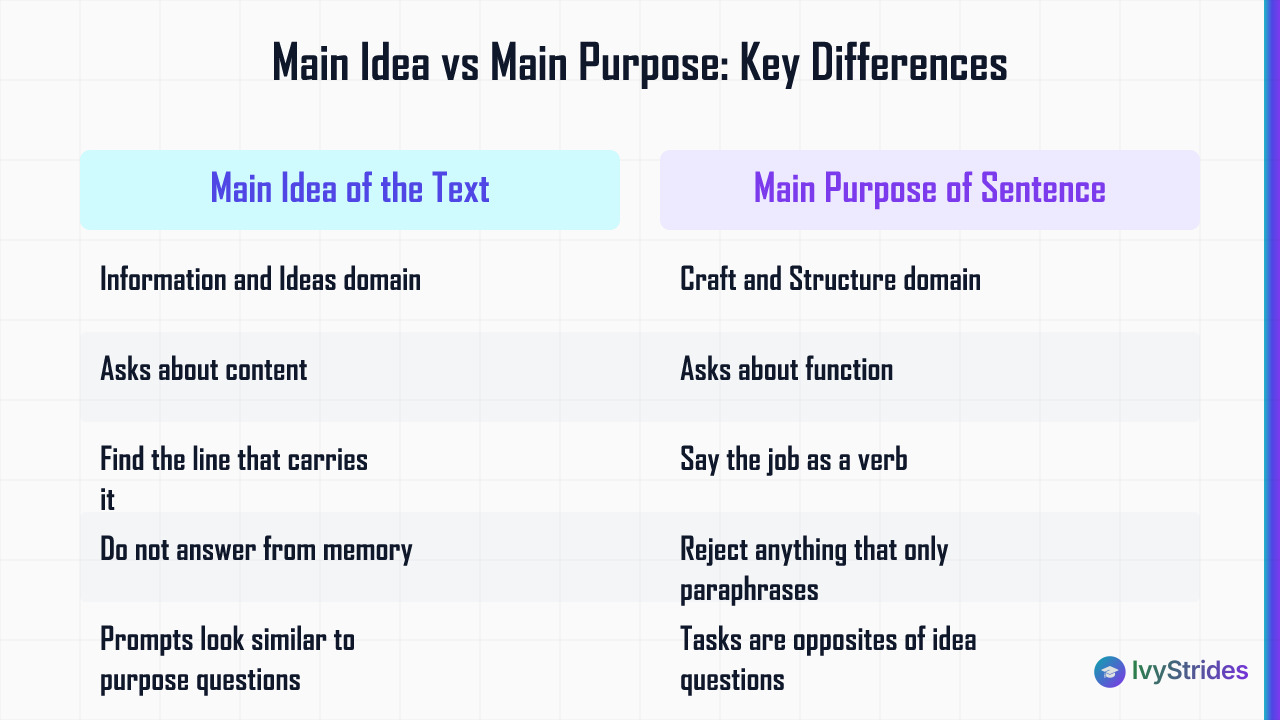
Two prompts are worth memorising because students confuse them constantly. "The main idea of the text" is Information and Ideas and asks about content. "The main purpose of the underlined sentence" is Craft and Structure and asks about function. The words look similar and the tasks are opposites.
How to Find Out Which Question Types Cost You Points
Log every SAT Reading and Writing miss by question type rather than by date, and the pattern shows up within about three practice sessions.
A practice-test score can't do this for you. "Reading and Writing 620" tells you the total and hides the distribution entirely, and students routinely assume their losses are spread evenly across the section when they're actually concentrated in one or two question types. Concentrated weakness is good news, because it's a much smaller problem to fix than a general one.
The method is simple enough to keep up. After each set, write down every miss with its domain and question type. Once a fortnight, count them. If eleven of your fifteen misses are rhetorical synthesis, you don't have a Reading and Writing problem, you have a goal-sentence problem, and that's a week of focused work rather than months of general practice.
One reason to do this early rather than late: the section is adaptive. Your performance across the first module determines the difficulty of the second, and the harder second module is where the higher score bands live. A weakness that shows up in Module 1 costs you more than the same weakness would cost in Module 2. How Module 1 sets your score ceiling covers the routing in detail.
Frequently Asked Questions About SAT Reading and Writing Question Types
How many questions of each type are on the Digital SAT?
College Board publishes the four domains and the question types within them, but not a fixed per-domain count for every form, and the section is adaptive. What is published: 54 questions across two 27-question modules, with every module drawing from all four domains.
Do the question types appear in a set order?
No. The domains are interleaved through both modules, so you'll switch between them constantly. That's why recognising a question type from its prompt wording matters more than it would on a blocked test.
Which Reading and Writing question type is hardest?
It varies by student, which is the point of logging errors by type. Rhetorical synthesis is the most commonly misunderstood, because true answers can be wrong. Standard English Conventions is usually the most improvable, because the rules are finite.
Should I study all four domains at once?
Start with the domain your error log says is costing you most, and start with Conventions if the log is inconclusive, since it returns the fastest. Spreading effort evenly across four domains treats a specific problem as a general one.
Are the Reading and Writing question types the same on the PSAT?
The PSAT/NMSQT uses the same four content domains, so the skills transfer directly. The section lengths differ, so check the format details before assuming timing carries across.
Does the SAT still have a separate writing section?
No. Reading and Writing is a single section on the Digital SAT, and grammar questions live inside it as the Standard English Conventions domain rather than in a section of their own.
Your Next Step on Reading and Writing
Do three things on the SAT Reading and Writing section: name the domain, apply its method, and log every miss by type. That sequence turns a section score into a specific, fixable list.
If you want that list without building it yourself, it comes from a diagnostic with the items categorised rather than from a practice-test total. You can read how we structure that on the IvyStrides about page. You can also meet the tutors who coach Reading and Writing specifically.
Fix the domain, not the section
Reading and Writing coaching built from a categorised error log.


Comments