

ACT vs SAT: Key Differences, Difficulty & Which Test Is Right for You
- prabaram1
- Jun 2, 2025
- 13 min read

Updated 21 August 2026
The ACT and SAT are accepted equally by every U.S. college, including all eight Ivy League schools. The Digital SAT runs 2 hours 14 minutes, uses an adaptive two-module structure, and scores on a 400 to 1600 scale. The Enhanced ACT runs about 2 hours 5 minutes for the composite, follows a fixed linear format, scores 1 to 36, and now treats Science as an optional add-on. Neither test is universally harder. The right one is the test that matches how your brain actually works.
Those format figures come from College Board and ACT, Inc. official documentation, and this article reflects the post-March-2024 Digital SAT and the 2025 Enhanced ACT. The harder question, which test fits you specifically, is where the two-test diagnostic beats any blog opinion. The sections below cover format, timing, difficulty by skill type, math content, score concordance, college preferences, and a step-by-step way to decide.
ACT vs SAT at a Glance: The 60-Second Answer for 2026
The Digital SAT and Enhanced ACT are the two standardized tests U.S. colleges use to evaluate academic readiness alongside GPA, essays, and extracurriculars. Every U.S. college accepts both, and no admissions office documents a preference for one over the other.
Here's the structural split. The Digital SAT has two sections, Reading and Writing plus Math, delivered on the College Board Bluebook app, and it adapts: your Module 1 performance sets the difficulty tier of Module 2. The Enhanced ACT has three scored core sections, English, Math, and Reading, in a fixed order that never changes based on your answers, with Science and Writing added only if you choose to sit them.
Feature | Digital SAT | Enhanced ACT |
Total time (core) | 2 hr 14 min | about 2 hr 5 min |
Sections | Reading & Writing, Math | English, Math, Reading |
Score scale | 400 to 1600 | 1 to 36 |
Structure | Section-adaptive (two modules each) | Fixed linear |
Avg. time per question | about 82 seconds | about 57 seconds |
Science | None | Optional add-on |
Calculator | Permitted on all Math | Permitted on all Math |
Delivery | Fully digital (Bluebook) | Paper at most centers; online at select sites |
Wrong-answer penalty | None | None |
The core decision principle is simple to state and hard to skip: take one timed official practice test of each, convert both to a common scale using the concordance table, and commit to whichever produces the higher equivalent score. For a deeper look at each test's mechanics, see what is the Digital SAT and our guide to the Enhanced ACT format and sections.
Section structure per College Board and ACT, Inc. official documentation. Per-question timing is IvyStrides arithmetic from the published section lengths and question counts.
ACT vs SAT Format and Timing: Side-by-Side Comparison for 2026
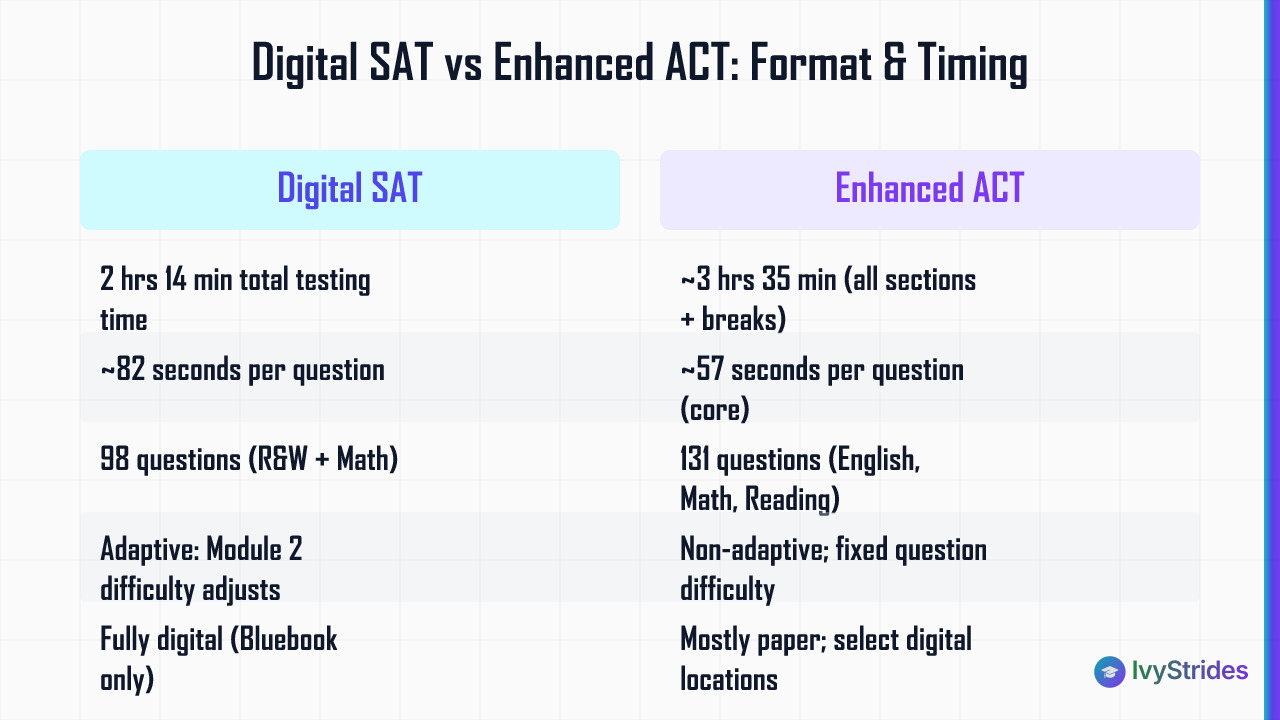
The Digital SAT and Enhanced ACT differ most in two places: how they're timed and how they respond to your answers. Getting these right changes your whole prep strategy.
Digital SAT. The Reading and Writing section runs 54 questions across two 27-question modules in 64 minutes. Math runs 44 questions across two modules in 70 minutes. Total testing time is 2 hours 14 minutes per College Board, which works out to roughly 82 seconds per question, the most generous pacing of either test.
The adaptive piece matters. In each section, Module 1 mixes easy, medium, and hard questions. Your performance on Module 1 routes you into a harder or easier Module 2, and that routing sets your scoring ceiling. Do well on Module 1 and you reach the higher score band. For the full mechanics, see SAT adaptive testing explained. For the minute-by-minute layout, see SAT time breakdown.
Enhanced ACT. The scored core is English (50 questions, 35 minutes), Math (45 questions, 50 minutes), and Reading (36 questions, 40 minutes). The composite averages those three, per ACT, Inc. Science is now an optional 40-question, 40-minute add-on that costs $5 extra and yields a separate score plus a STEM score. Writing is one essay in 40 minutes for $25 extra. Add both and test day, including breaks, stretches toward roughly 3 hours 35 minutes.
The ACT gives you far less time to think: around 57 seconds per question on the core, versus the SAT's 82. That single number, the pacing gap, drives most students' preference more than content ever does.
One more practical split. The Digital SAT is fully digital on Bluebook, no paper option. The ACT is still paper-based at most test centers, with online delivery at select locations. On cost, ACT base registration for the English, Math, and Reading composite is $70; Science adds $5, Writing adds $25, and all sections plus Writing runs $100, per the ACT, Inc. official fee schedule.
Is the ACT Harder Than the SAT? The Honest Answer by Skill Type
Neither the ACT nor the SAT is objectively harder; difficulty is student-specific and shows up along three fault lines: pacing, reasoning depth, and whether data interpretation plays to your strengths. Anyone who tells you one test is flatly easier is guessing at your cognitive profile.
Start with pacing, because it's the biggest lever. The ACT gives you about 57 seconds per question on the core; the SAT gives you about 82. That's roughly 40 percent more time per question on the SAT. In our coaching, ACT pacing is the single most common reason students underperform relative to what they actually know. They can do the algebra. They just can't do it in 50 seconds while a timer runs.
Reasoning depth cuts the other way. Digital SAT questions tend to demand more layered reasoning per item, and the adaptive structure means a shaky Module 1 caps your ceiling before you've settled in. A student who reads fast and works cleanly under time pressure often finds the ACT's shorter, more direct questions a better fit.
Then there's ACT Science. It's optional now, but if you add it, understand what it tests: data interpretation and scientific reasoning across three passage types, data representation, research summaries, and conflicting viewpoints. It does not test memorized biology or chemistry facts. Students who've built graph-and-table fluency in AP science courses often read those passages faster than the ACT's clock demands.
On math content, the split is real. SAT Math emphasizes algebra, advanced math, and data analysis. ACT Math ranges wider, pulling in trigonometry and pre-calculus that the SAT touches only lightly. English and grammar look similar on the surface: the ACT English section and the SAT's Standard English Conventions questions both test punctuation, agreement, and concision, just at different speeds.
So who scores higher where? In our coaching, students who struggle with pacing under pressure tend to score relatively higher on the SAT, while fast, systematic readers tend to score relatively higher on the ACT. As one anonymized pattern: a student who scored around 1280 SAT and 27 ACT on diagnostics chose the SAT on concordance and reached roughly 1430 across about 10 weeks of targeted Reading & Writing and Math work with a section-specialist coach. That's typical for the 1280 band in our 1-on-1 SAT program, not a promise. For the content details, see SAT Math topics and our ACT section-by-section prep guide.
Not Sure Which Test Fits You? Find Out in 15 Minutes.
Book a free strategy call with an IvyStrides coach. We will review your diagnostic scores, identify your stronger test, and map out a prep plan built around your actual weaknesses, not a generic curriculum.
ACT vs SAT Math: What Each Test Actually Asks You to Do
SAT Math and ACT Math test overlapping skills through different lenses. SAT Math is 44 questions in 70 minutes across four domains: Algebra, Advanced Math, Problem-Solving and Data Analysis, and Geometry and Trigonometry, per College Board. ACT Math is 45 questions in 50 minutes covering pre-algebra through pre-calculus, including a heavier dose of trigonometry.
The content weighting tells the story. On the SAT, roughly 30 percent of Math questions fall under Problem-Solving and Data Analysis: ratios, percentages, unit conversions, and reading data from tables and graphs. The style leans toward multi-step reasoning and word problems where setting up the equation is half the battle.
ACT Math spreads across a broader content range with more direct computation per item. You'll see more "solve this" questions, but you'll also see topics the SAT rarely emphasizes, like matrices, logarithms, and more trig identities. The trade is breadth for depth: the ACT asks about more topics, the SAT digs deeper into fewer.
SAT Math | ACT Math | |
Questions / time | 44 in 70 min | 45 in 50 min |
Content span | Algebra, Advanced Math, Data Analysis, Geometry & Trig | Pre-algebra through pre-calculus, incl. trig |
Question style | Multi-step reasoning, word problems | Broader range, more direct computation |
Calculator | Permitted on all questions | Permitted on all questions |
Both tests now permit a calculator on every math question. On the SAT, a no-calculator mindset still pays off: the fastest scorers reach for the built-in Desmos tool selectively, not reflexively. In our coaching, students with strong algebra foundations but limited trig exposure tend to score relatively higher on SAT Math, while students who've completed broad coursework through pre-calc tend to score relatively higher on ACT Math. For the full domain map, see SAT math topics 2026. To understand how these scale, read SAT scores explained.
ACT to SAT Score Conversion: What a 27, 33, or 36 ACT Equals on the SAT
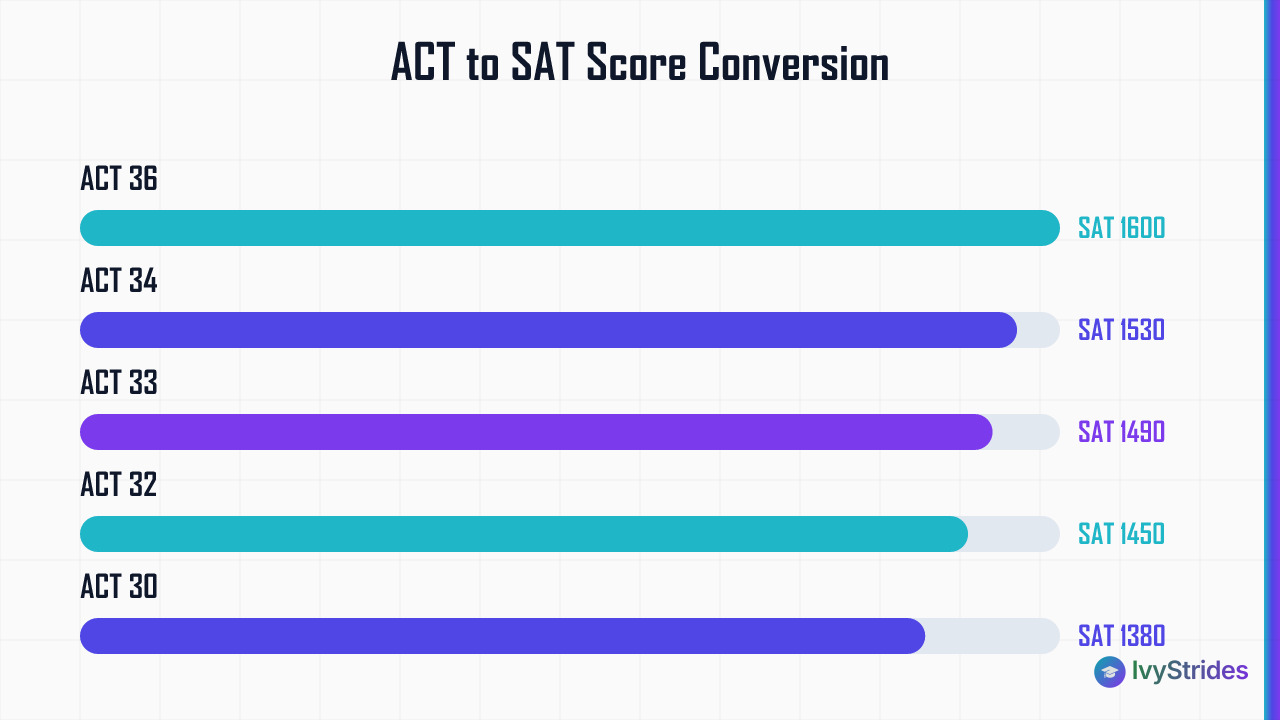
The College Board publishes an official SAT-ACT concordance table that lets you compare a score on one test to its equivalent on the other. This is the tool that turns two different scales, 400 to 1600 and 1 to 36, into a single apples-to-apples comparison for deciding which test to submit.
Here are the key pairs from the official concordance:
ACT Composite | Equivalent SAT (approx.) |
36 | 1600 |
34 | 1530 |
33 | 1490 |
32 | 1450 |
30 | 1380 |
27 | 1210 |
22 | 1060 |
A 1450 SAT lands right around a 32 ACT, and a 33 ACT maps to roughly a 1490 SAT, per the College Board concordance. A 27 ACT translates to about a 1210 SAT.
Is a 36 ACT harder to earn than a 1600 SAT? In any given year, fewer students score a perfect 36 than a perfect 1600, but the gap is marginal and both demand near-flawless performance across every section. Admissions offices treat them as equivalent, full stop. Neither perfect score gives an edge over the other.
One caveat worth holding onto: concordance is a statistical average, not a personal prediction. Your actual score on each test can drift from the predicted equivalent because your individual strengths, reading speed, trig comfort, pacing tolerance, don't average out the way the population does. That's exactly why the two-test diagnostic beats the conversion chart. If you already have a score on one test and want the complete table walked through, see our SAT to ACT score concordance guide. To benchmark a target, read what is a good SAT score.
Do Colleges Prefer the ACT or SAT? What Admissions Officers Actually See
No U.S. college prefers the ACT or the SAT. Every accredited four-year institution, including Harvard, Yale, Princeton, and the rest of the Ivy League, accepts both tests equally, and none documents a preference in its admissions materials or Common Data Set. An admissions reader sees a 34 ACT and a 1500 SAT as the same signal.
This surprises families every year, so let's be blunt: the old regional folklore, "the ACT is a Midwest test, the SAT is a coastal test," has no bearing on how any selective school reads an application today. Submit the test on which you score higher relative to its scale. That's the entire preference question, answered.
Test-optional policy is the real wrinkle. Whether a school requires a score at all varies by institution and changes year to year; several highly selective schools have moved back toward requiring scores after test-optional stretches. Verify each target school's current policy at the source, and cross-check the FairTest tracker before you decide whether to submit. Test scores are one part of a holistic application; your college admissions essays carry equal weight at selective schools, and both benefit from starting early.
Here's the part most students miss about test-optional: it does not mean scores don't matter. At a school where the middle-50 percent SAT range sits around 1500 to 1570, submitting a 1520 or an equivalent 34 ACT typically strengthens your file even when submission is optional. A score at or above the admitted-class range is evidence you'd rather have on the table than off it.
Both tests also support superscoring, combining your best section scores across multiple sittings. College Board superscores the SAT and ACT, Inc. superscores the ACT, but each college sets its own policy on whether it accepts a superscore, so confirm per school. The standing caveat on everything here: admissions outcomes depend on the full application, GPA, rigor, essays, activities, not on a test score alone. For the current landscape, see do colleges require SAT in 2026. For the weight of the score itself, read how much does the SAT matter for college admission.
How to Decide Between the ACT and SAT: A Two-Test Diagnostic Framework
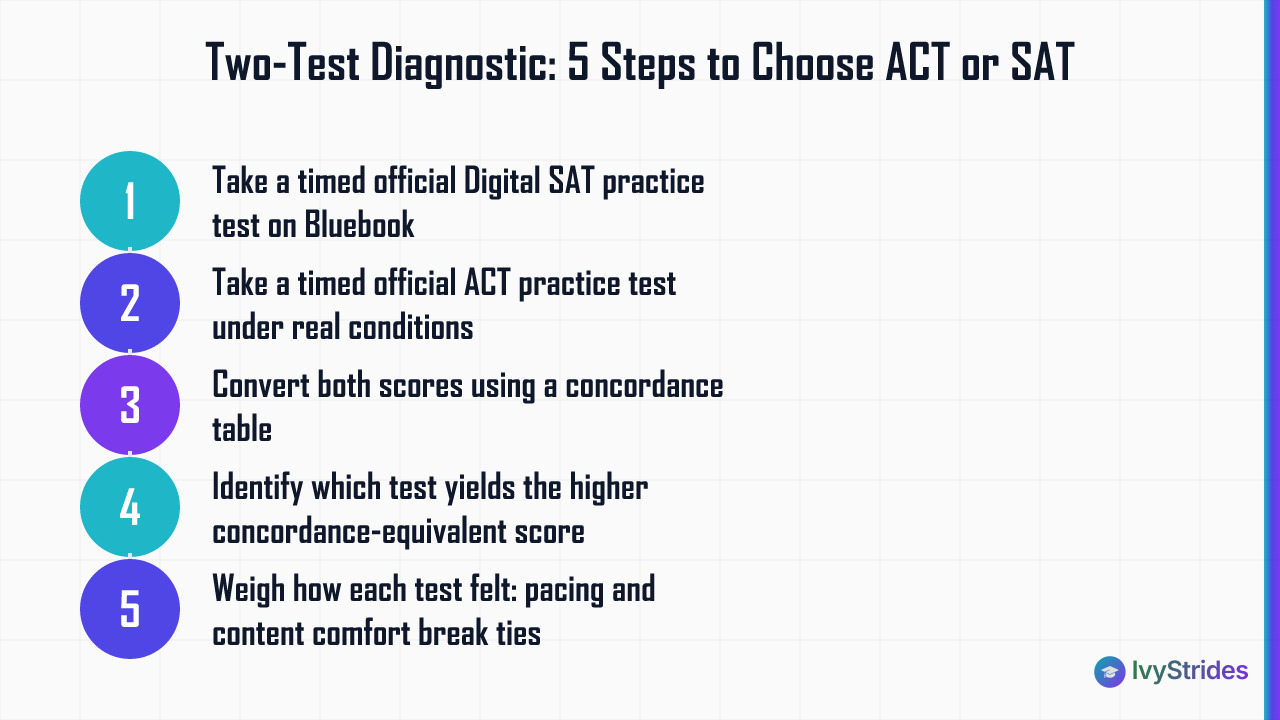
The reliable way to choose between the ACT and SAT is a two-test diagnostic: sit one timed official practice test of each, convert both to a common scale, and commit to the higher equivalent. Opinions and quizzes guess at your strengths. A timed diagnostic measures them.
Run it in five steps:
1. Take one timed official Digital SAT practice test on the free Bluebook app from College Board. Full length, full timing, no pausing.
2. Take one timed official ACT practice test from the free materials at ACT, Inc.. Match real conditions again, including whether you'll add Science.
3. Convert both scores using the concordance table above.
4. Identify the higher concordance-equivalent score. If your SAT converts to a 31 ACT and you scored a 28 on the actual ACT, the SAT is your test on the numbers.
5. Weigh how each test felt. Which pacing left you less rushed? Which content felt more familiar? When the scaled scores are close, comfort and pacing tolerance break the tie.
Timing matters as much as method. The natural windows to run both diagnostics are sophomore spring, around April or May, or junior fall, around September or October. Either leaves roughly 3 to 6 months for focused prep before a target test date. In our coaching, students who run both diagnostics before committing typically avoid roughly 6 to 8 weeks of prep spent on the wrong exam, the most expensive mistake in this whole process, measured in time you don't get back.
Juniors planning on the SAT should also sit the PSAT/NMSQT in October of 11th grade. It doubles as a free SAT diagnostic and the qualifying exam for the National Merit Scholarship Program, where a strong Selection Index can open scholarship pathways.
When should you take both official tests? If your two diagnostics land within a few concordance points of each other, sitting both real exams and submitting the stronger score is a defensible play. Colleges don't penalize you for it. But if one test is clearly ahead by more than a point or two of ACT equivalent, split your prep hours and go all-in on the winner.
Once you've picked a test, the IvyStrides methodology takes over, and it starts from that real practice test, never a placement quiz. We run diagnostic, targeted weakness work, spaced retesting, and section-specialist coaching: separate coaches for SAT Reading & Writing, SAT Math, ACT English and Reading, ACT Math, and ACT Science, because a Reading specialist and a Math specialist aren't the same person. You can read more about the team on the IvyStrides tutors page. Once you've chosen the SAT, a diagnostic practice test is the starting point for a structured plan; see our SAT study plan for customizable schedules from six days to six months.
To build the calendar, check SAT test dates 2026–2027. For the ACT calendar, see ACT test dates 2026–2027. To source realistic practice material, start with the best SAT practice tests in 2026.
Pros and Cons of the ACT vs SAT: A Balanced Summary
Weighing the ACT and SAT comes down to trade-offs in pacing, structure, content breadth, delivery format, and cost. Here's the honest ledger, with no thumb on the scale.
Pros | Cons | |
Digital SAT | More time per question (about 82s); adaptive structure rewards a strong Module 1; fully digital and simpler on Bluebook; no Science section to prep | Adaptive routing means a weak Module 1 caps your ceiling; no paper option for students who prefer it |
Enhanced ACT | Paper option at most centers; Science rewards data-fluent students; broader math suits strong pre-calc backgrounds; Science and Writing are optional, so you can skip what doesn't help | Faster pace (about 57s/question) pressures slower readers; Science costs $5 extra; Writing costs $25 extra |
On cost, ACT base registration is $70 for the composite, with Science at $5, Writing at $25, and all sections plus Writing at $100, per the ACT, Inc. fee schedule. SAT registration runs on College Board's separate schedule; for the current domestic and international breakdown, see SAT fees 2026. For the ACT side in detail, read how much does the ACT cost.
Format preference is more than aesthetics. In our coaching, students with diagnosed reading processing differences sometimes prefer the ACT's paper format because it lets them annotate freely, while students who navigate digital interfaces comfortably often find the SAT's Bluebook experience smoother, especially the built-in Desmos calculator and answer flagging. Neither preference is right or wrong; it's about which environment lets you show what you know.
FAQ: ACT vs SAT
Is the SAT harder or the ACT?
Neither is universally harder. The ACT moves faster at about 57 seconds per question versus the SAT's roughly 82, which strains students who need processing time. The SAT's adaptive structure means a weak Module 1 limits your ceiling. Difficulty is student-specific, so a timed diagnostic on each is the only reliable read on which fits you.
Is a 36 ACT harder to get than a 1600 SAT?
Both are perfect scores on their scales, and colleges treat them identically. Statistically, slightly fewer students earn a 36 ACT than a 1600 SAT in a given year, but the difference is marginal and both require near-flawless work across every section. Neither perfect score carries an admissions advantage over the other.
Does Harvard prefer the ACT or SAT?
Harvard accepts both tests equally and documents no preference for either. The same holds for Yale, Princeton, and every Ivy League school. What matters is your score's strength relative to the admitted class range, not which test produced it. Always verify each school's current test policy before you apply, since requirements change year to year.
What ACT score is equivalent to a 1450 SAT?
A 1450 SAT is approximately a 32 ACT on the College Board's official concordance table, and a 33 ACT maps to roughly a 1490 SAT. Treat the conversion as a guide rather than a guarantee: your individual scores on each test can vary based on pacing tolerance and content strengths.
Can you take both the SAT and ACT?
Yes. No rule prevents it, and colleges don't penalize applicants who sit both. Many students take a timed practice test of each, focus prep on whichever produces the higher concordance-equivalent score, and then submit the stronger result. If your two diagnostics land close, sitting both real exams is a reasonable strategy.
Is a 27 a good ACT score?
A 27 ACT composite sits above the national average and lands around the 85th percentile, making it competitive for many four-year colleges. It falls below the middle-50 range at highly selective schools, where the typical band runs roughly 33 to 36. A 27 ACT is approximately equivalent to a 1210 SAT on the concordance table.
Which test is better for students who are not native English speakers?
Neither test is built for non-native English speakers, but the SAT's longer time per question can ease pacing pressure for students still building reading fluency. The ACT's Science section rewards data interpretation over English fluency, which some international students find helpful. Running a timed diagnostic on both remains the most reliable way to decide.
What is the purpose of the SAT and ACT?
Both are standardized college admissions tests U.S. colleges use to gauge academic readiness alongside GPA, essays, and extracurriculars, and both serve as merit scholarship qualifiers at many universities. The PSAT/NMSQT, a shorter SAT-aligned test, additionally qualifies students for the National Merit Scholarship Program.
Choosing between the ACT and SAT isn't a personality quiz or a coin flip; it's a measurable decision you make once, with data, and then stop second-guessing. Run both diagnostics, read the concordance, pick your test, and put your prep hours where they'll actually move a score. To see how we work, read the IvyStrides About page.
Ready to Stop Guessing and Start Prepping the Right Test?
Take a free 15-minute strategy call with an IvyStrides section-specialist coach. We will look at your diagnostic results, confirm your target test, and give you a concrete first week of prep, no commitment required.



Comments