

What Is a Good SAT Score 2026: Benchmarks, College Targets, Percentiles & FAQs
- prabaram1
- Oct 25, 2025
- 12 min read

Updated 21 August 2026
The SAT is a standardised college admissions test scored from 400 to 1600, combining a Reading and Writing section and a Math section. A good SAT score in 2026 depends on your target colleges. Nationally, the average composite is around 1030 to 1050. A score of 1200 places you near the 75th percentile and is competitive at many regional universities. A 1350 or higher puts you in the top 10 percent of test takers. For highly selective schools, the middle 50 percent of admitted students typically falls between 1400 and 1550, and Ivy League scores above 1500 are generally competitive. The right target is the one that meets or exceeds the middle 50 percent range at your specific schools.
Those percentile figures come from College Board official data, and the school-specific ranges below trace to each college's Common Data Set. The harder question is not "what is a good score" in the abstract. It's whether your score is good enough for your list, and whether the gap is worth the time and money of a retake. That's what the rest of this page answers, tier by tier and band by band.
What the SAT Score Scale Looks Like in 2026: 400 to 1600 Explained
The SAT composite score is a single number on a 400 to 1600 scale, built from two section scores of 200 to 800 each. The two sections are Reading and Writing (R&W) and Math. Add the two section scores and you get the composite. A perfect score is 1600. All 2026 scores reflect the Digital SAT format, live since March 2024.
Here's what changed with the digital move, and why it matters for reading your score. Each section runs in two adaptive modules. Your performance on Module 1 routes you into an easier or harder Module 2. Do well on Math Module 1 and you're sent to a harder Module 2 that carries more scoring weight. A hard-module student and an easy-module student can answer the same number of questions right and land on very different section scores.
That routing has a real ceiling effect. If you're sent to the easier Module 2, your section score is capped below the top of the 200 to 800 range no matter how many questions you get right. This is why raw question count doesn't map cleanly to your score.
To understand where your score sits, it helps to know how the Digital SAT's adaptive modules convert raw performance into the 400 to 1600 composite; see our full breakdown of how the Digital SAT is scored. For a deeper look at how section scores combine into your composite and what the percentile bands mean at each point on the scale, our SAT scores explained guide covers the full picture.
2026 SAT Percentile Benchmarks: Where Does Your Score Actually Rank?
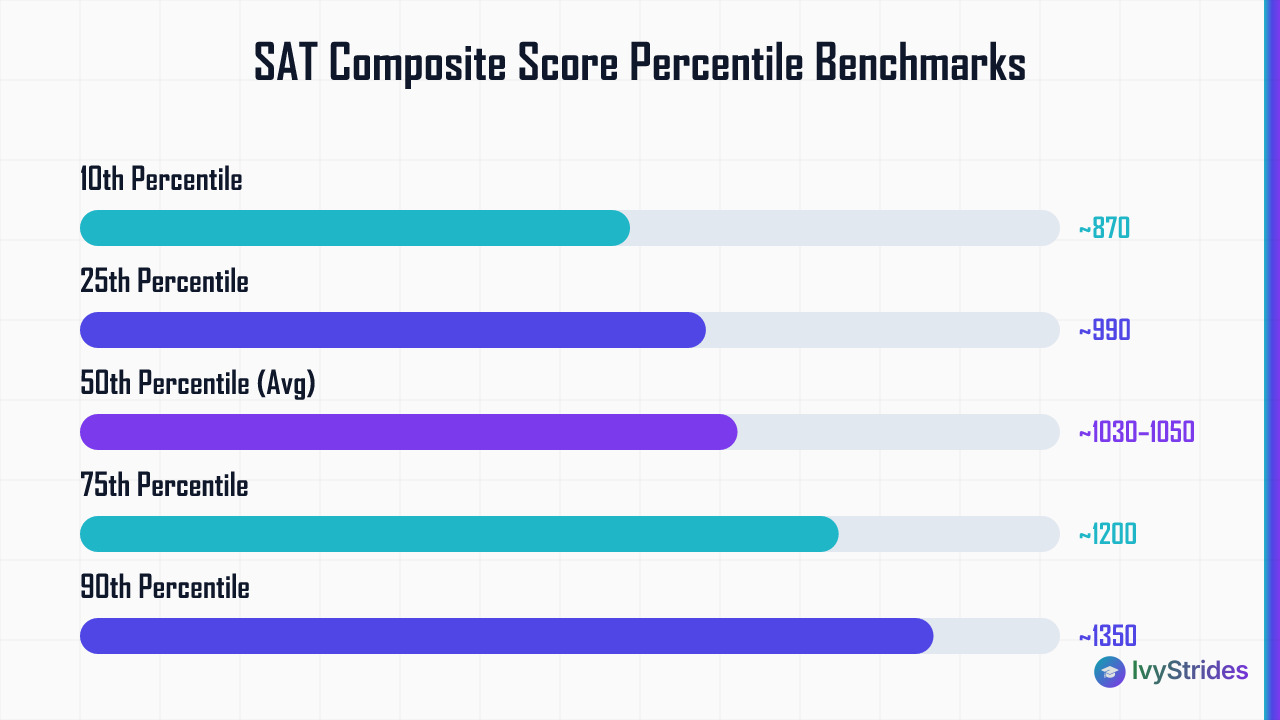
A percentile rank tells you the share of test takers you scored above. Score at the 75th percentile and you scored higher than roughly 75 percent of students who took the test. The national average composite in 2026 is approximately 1030 to 1050, according to College Board data, which sits right at the 50th percentile.
Here's the approximate composite-to-percentile map, using College Board's published percentile data for the Digital SAT:
Composite score | Approximate percentile | What it means |
~870 | 10th | Bottom slice nationally |
~990 | 25th | Below average |
~1030–1050 | 50th | National average |
~1200 | 75th | Top quarter |
~1350 | 90th | Top 10 percent |
~1550+ | 99th | Top 1 percent |
Source | College Board SAT percentiles | Verified 21 August 2026 |
Section-level averages sit a little apart. R&W averages around 520 and Math around 500, per College Board. So a "balanced" average score of 1030 usually leans slightly more R&W than Math, which surprises students who assume the two sections score identically.
Two thresholds matter most for goal-setting. The top 10 percent starts around 1350. The top 1 percent starts around 1550 to 1570. If a school's admitted class clusters in the top few percent, you now know roughly what number that implies. Want to convert a raw practice count into a projected composite? Our SAT score calculator does the module math for you.
What Is a Good SAT Score for College? A Tier-by-Tier Breakdown
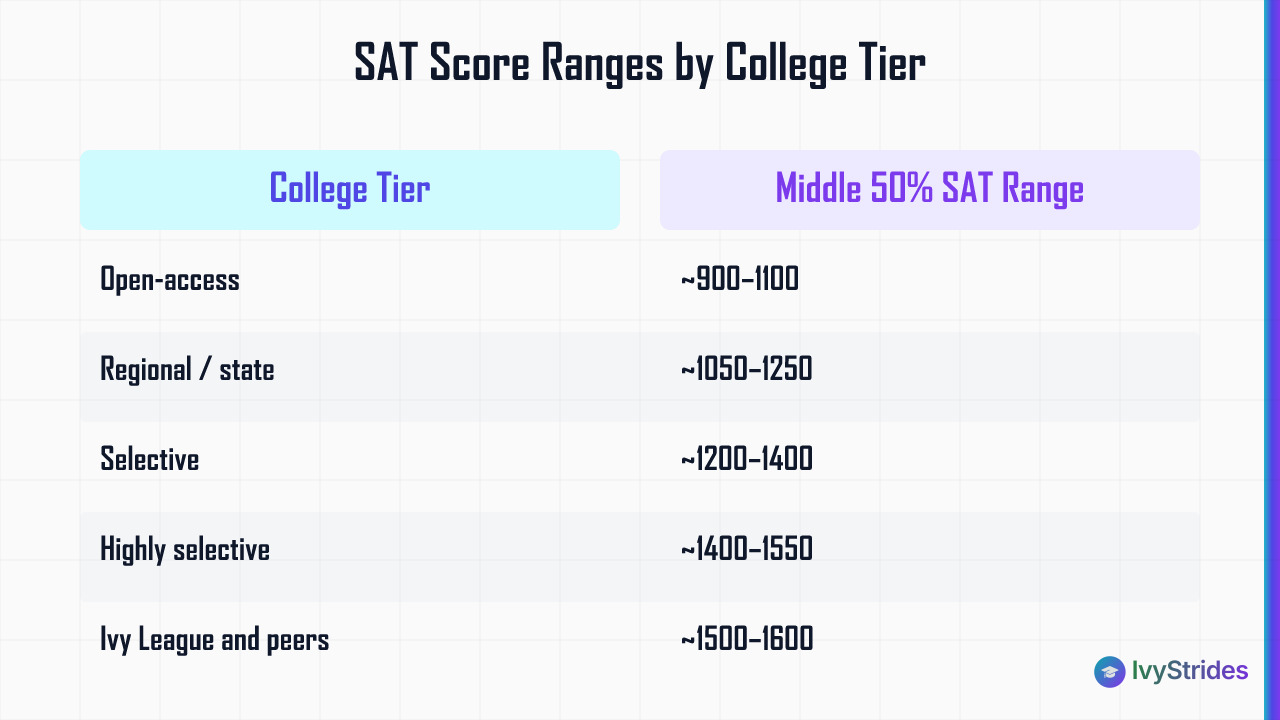
A good SAT score for college is any score that lands inside or above the middle 50 percent range of admitted students at the schools on your list. There is no single national cutoff. A 1100 that's competitive at one state flagship is below the range at another. So the useful question isn't "is my score good," it's "good for where."
Here's how score ranges map to college selectivity tiers:
College tier | Typical middle 50% SAT range | Example schools |
Open-access | ~900–1100 | Many community and regional colleges |
Regional / state | ~1050–1250 | Non-flagship state universities |
Selective | ~1200–1400 | University of Florida, Purdue, UT Austin |
Highly selective | ~1400–1550 | Georgetown, Vanderbilt, Carnegie Mellon |
Ivy League and peers | ~1500–1600 | Harvard, Yale, MIT, Stanford |
The named-school ranges above are illustrative tiers; always confirm each school's current middle 50 percent in its Common Data Set, since ranges shift year to year.
So, is 1000 a good SAT score? It's right at the national average and above the floor for open-access institutions, but below the middle 50 percent at most four-year selective schools. Is 1100 a good SAT score? It's above average and competitive at many state universities outside the top flagship tier, though borderline once you're aiming at selective schools.
Test-optional policies vary by school and year; even at test-optional schools, a score above the middle 50 percent of admitted students typically strengthens an application. Don't read "test-optional" as "score-irrelevant." For a fuller treatment of when scores are required versus optional, see Do Colleges Still Require the SAT in 2026. On the weighting question, read how much the SAT matters for college admission. Check each school's current admissions page and the FairTest tracker before you decide to withhold a score.
What Is a Good SAT Score for Ivy League and Highly Selective Colleges?
A good SAT score for the Ivy League generally means 1500 or higher. The middle 50 percent of admitted students at most Ivies runs from the low 1500s into the high 1500s, so a score below roughly the 25th percentile of your target school's admitted class is a hard sell as a standalone number. These are the tightest ranges in American admissions.
Here are approximate middle 50 percent composites at several Ivy and peer institutions, drawn from each school's Common Data Set:
School | Approximate middle 50% SAT |
Harvard | ~1550–1580 |
Yale | ~1530–1570 |
Princeton | ~1510–1570 |
Cornell | ~1470–1560 |
MIT, Stanford, Duke, Johns Hopkins (peers) | ~1500–1580 |
Confirm each figure against the specific school's Common Data Set for the current cycle before you set a target, since these ranges move.
Is 1400 a good SAT score for the Ivy League? Honestly, no, not as a standalone score. A 1400 is strong nationally, roughly the top 10 to 15 percent, but it falls below the 25th percentile at most Ivy League schools. It's competitive at many highly selective schools outside the Ivies. For an Ivy list, treat 1400 as a mid-point on the way to a 1500-plus target.
Superscore policy softens this a little. Most Ivies superscore, meaning they take your highest R&W and highest Math across multiple sittings. A student who scored 1380 with strong R&W in October and 1420 with stronger Math in December could present a superscore above both individual composites. Plan your sittings so each targets a different section peak.
One caveat outranks every number here: admissions outcomes depend on the full application, not test scores alone. A score inside the middle 50 percent does not admit you, and a score below it does not lock you out; it shifts probability, that's all. Students targeting these schools should read our detailed analysis of whether a 1500 SAT score is good enough for Ivy League admission. If you're near the top of the range, we also break down whether a 1540 SAT score is good enough for Harvard, Yale, and Princeton.
SAT Score Band Verdicts: Is Your Score Good Enough to Submit?
Whether to submit or retake comes down to one rule: if your score is below the 25th percentile of admitted students at your target school, a retake is worth the investment. Above the median, submit and move on. The band-by-band verdicts below assume a mixed target list; adjust for your specific schools.
Your score band | National standing | Verdict |
Below 900 | Below 25th percentile | Strong retake candidate; competitive only at open-access schools |
900–1100 | Average to slightly above | Retake if targeting selective schools; solid for regional |
1100–1200 | Above average | Competitive at many state universities; borderline for selective |
1200–1300 | ~75th percentile | Solid for selective schools; below middle 50% at highly selective |
1300–1400 | Top 25% | Competitive at selective; below middle 50% at Ivy tier |
1400–1500 | Top 10–15% | Competitive at highly selective; borderline at Ivy tier |
1500–1600 | Top 5–7% | Competitive at Ivy League and peers |
So is 1200 a good SAT score? Yes for a lot of lists, no for others. It sits around the 75th percentile nationally and clears the bar at many regional and selective state schools, but it's below the middle 50 percent at highly selective ones. Is 1300 a good SAT score? It's top-quartile territory and solid for selective schools, though still short of the Ivy-tier range. Is 1500 a good SAT score? It's in the top 5 to 7 percent and competitive at the most selective schools in the country. If your current score is around 1300 and you're weighing whether to retake, our dedicated article on whether a 1300 SAT score is good enough covers the colleges that accept it and what to do next.
A retake only helps if you've got room and a plan. Multiple attempts move your submitted number only when the school superscores or takes your single best sitting. Before you register again, check how many attempts make sense: how many times can you take the SAT. And if your SAT score is not moving after two attempts, it may be worth exploring whether the ACT format suits your strengths better; some students who plateau on the Digital SAT's reading-heavy R&W section score higher on the ACT's separate English and Reading sections.
Here's the part most students miss. In our coaching, we frequently see students submit scores that are 50 to 100 points below their target school's 25th percentile simply because they never checked where their score ranked against that specific admitted class. The retake decision isn't about your score in the abstract. It's about the gap to your list.
Not Sure If Your SAT Score Is Good Enough for Your Target Schools?
Book a free 15-minute strategy call. An IvyStrides coach will review your current score, compare it to your target-school ranges, and give you a concrete plan to close the gap.
What Is a Good SAT Score by Section: Reading and Writing vs. Math
Section scores decide where your improvement time should go, because a composite hides imbalance. The SAT Reading and Writing section and the SAT Math section each run 200 to 800. The two sections do not average out evenly: Reading and Writing typically sits a little above Math nationally. For most colleges, a 600 in either section is good. For selective schools, aim for 700-plus per section. For the Ivy tier, 750-plus.
Look at what a composite conceals. A student with 700 R&W and 550 Math scores a 1250, which sounds competitive. But that Math score sits below average, and it's the reason a 1400 target feels out of reach. The composite is fine; the Math section is the constraint. Fix the section, and the composite moves on its own.
Section score | R&W verdict | Math verdict |
~520 / ~500 | National average | National average |
600+ | Good for most colleges | Good for most colleges |
700+ | Competitive for selective | Competitive for selective |
750+ | Ivy-tier range | Ivy-tier range |
This is exactly why IvyStrides pairs students with separate R&W and Math coaches rather than one generalist tutor. The student above doesn't need "SAT tutoring." They need a Math specialist working the specific Digital SAT Math domains where they're losing points. If Math is your constraint, start by identifying weak areas in our guide to SAT Math topics. If R&W is holding you back, work through strategy for the Information and Ideas domain on the Digital SAT, one of the four R&W content domains.
How to Close the Gap Between Your Current SAT Score and Your Target
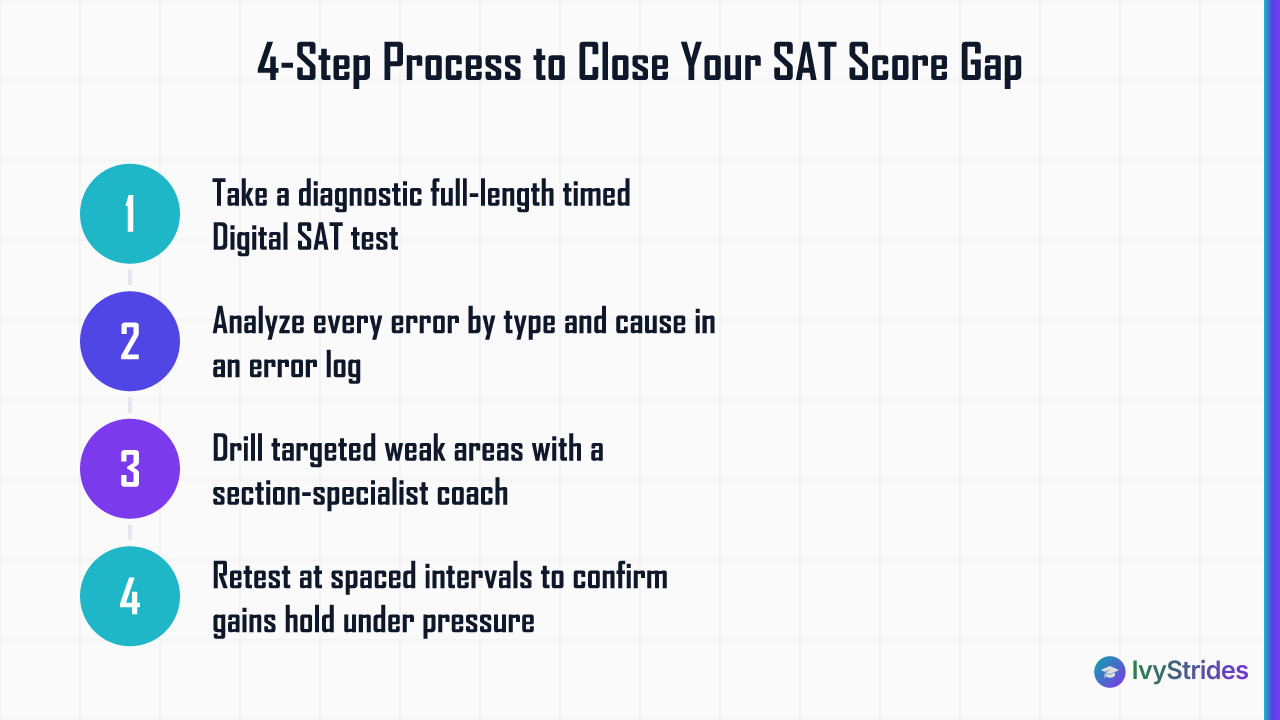
The gap closes through one method: a diagnostic full-length practice test first, then targeted work on exactly what the diagnostic exposes, then spaced retesting to lock it in. Everything else is guesswork. You cannot fix weaknesses you haven't measured, and a real practice test is the only honest measurement.
Here's the sequence we run in our 1-on-1 SAT prep:
1. Diagnostic full-length test. A real, timed Digital SAT with adaptive modules. This gives your true starting composite and section scores.
2. Error-log analysis. Every missed question gets categorized by type and cause, not just marked wrong. Our SAT mistake tracker is the tool for this.
3. Targeted weak-area drilling. You work the specific question types and domains where you're losing points, with a section-specialist coach.
4. Spaced retesting. Full-length retests at intervals to confirm gains hold under timed pressure.
In our coaching with students in the 1100 to 1300 band, the most common gap is not raw knowledge but untargeted practice: students repeat the same question types they're already good at while avoiding the ones costing them points. That's why a 200-plus point improvement is typical for students who complete the full diagnostic-driven program, though it's never a guarantee and it depends on hours invested and consistency.
On timeline: a gain of roughly 150 to 200 points typically takes about three to six months of structured prep. A focused 50 to 100 point gain in a single section can come in roughly six to twelve weeks. Across students we've coached who started below 1200, those who completed a full program with section-specialist coaches typically reached their target within that three-to-six-month window.
Once you know your target score, the next question is how to close the gap; our step-by-step guide on how to improve your SAT score walks through the diagnostic-first method. For sourcing real full-length tests, see the best SAT practice tests in 2026. To structure your weeks, use our SAT study plan. If you have a PSAT score in hand, you can use it to project your SAT range and set a realistic target before you register, since the PSAT/NMSQT runs on a related scale and predicts SAT performance well.
Frequently Asked Questions About Good SAT Scores in 2026
Is a 900 SAT score good?
A 900 SAT score sits around the 25th percentile nationally, below the average of roughly 1030 to 1050. It's competitive at open-access and some community colleges but falls under the middle 50 percent range at most four-year universities. Students at this level are strong retake candidates, especially with a diagnostic-driven plan.
Is 1400 a good SAT score for the Ivy League?
A 1400 is strong nationally, roughly the top 10 to 15 percent, but it lands below the 25th percentile at most Ivy League schools, where middle 50 percent ranges typically start around 1470 to 1510. Outside the Ivies it remains a strong number at many highly selective schools. For an Ivy list, set your sights on 1500 or higher.
Is a 1200 a good SAT score?
A 1200 places you around the 75th percentile nationally and works well for many regional universities and selective state schools. It's below the middle 50 percent at highly selective schools. If your list includes schools with a middle 50 percent above 1300, a retake is worth considering; check each school's Common Data Set.
What SAT score puts you in the top 1%?
A score of approximately 1550 or higher places you in the top 1 percent of test takers, based on College Board percentile data. A perfect 1600 is the ceiling. Very few test takers reach 1580 or above in any given year, which is why these scores anchor the most selective admitted classes.
Should I retake the SAT if I got a 1200 or 1300?
It depends on your target schools. When your score sits below the 25th percentile of admitted students at colleges on your list, a retake earns its cost. A 1200 works for many regional schools but comes in below the middle 50 percent at selective universities. A 1300 holds up at selective schools but stops short of the highly selective range.
Is 1000 a good SAT score?
A 1000 is roughly at the 50th percentile nationally, so it's average. It's competitive at open-access colleges and some regional schools but below the middle 50 percent at most four-year selective universities. Students with a 1000 who are targeting selective schools should plan a structured retake with a clear section focus.
Is a 1500 SAT score good?
A 1500 is excellent, placing you in approximately the top 5 to 6 percent of test takers nationally. It's competitive at highly selective universities and within the middle 50 percent at several Ivy League schools. Whether it clears the bar for a specific school depends on that school's admitted-student range.
What is considered a good SAT score for scholarships?
Merit scholarship thresholds vary widely by institution. Many automatic merit awards at regional universities begin around 1200 to 1300. National Merit recognition runs through the PSAT/NMSQT Selection Index rather than the SAT directly, with state-specific cutoffs corresponding to roughly a 1400 to 1520 SAT equivalent. Check each school's scholarship page for exact cutoffs, and see how to set a realistic SAT score goal.
A good SAT score is the one that clears the middle 50 percent at the schools you actually want. You now have the percentile map, the tier ranges, and the retake rule to place your score against your list. The next move is turning that gap into a plan.
Ready to Turn Your SAT Score Into a College Admissions Asset?
A 15-minute call with an IvyStrides section-specialist coach gives you a diagnostic snapshot, a target-score plan, and a clear next step. No pressure, no commitment.


Comments