

How Long Is the SAT? Exact Timing, Extended Time, and When You Actually Finish (2026)
- Hemant Attray
- May 28, 2025
- 23 min read

Updated 21 August 2026
The digital SAT runs 2 hours and 14 minutes of testing time.
With the 10-minute break, the SAT runs 2 hours 24 minutes from the first module to the last. College Board's test-day schedule allows about 2 hours 30 minutes, because Bluebook adds untimed transition screens between modules.
Budget about 3 to 3.5 hours at the test center once you count check-in and dismissal, whether you are a parent arranging a pickup or a student planning the morning.
The three SAT time numbers
What it measures | How long | What it includes |
Testing time (College Board) | 2 hr 14 min (134 minutes) | The four timed modules only |
Test start to test end (IvyStrides) | 2 hr 24 min (144 minutes) | Testing time plus the single 10-minute break. College Board publishes both parts but not the total |
Total time at the test center (IvyStrides) | About 3 to 3.5 hours | Check-in from 7:45 a.m. through the published end of testing at 10:45 to 11:00 a.m., plus dismissal |
Which number do you actually need?
Testing time is the 134 minutes you spend inside the four timed modules. That clock runs while you read, review and navigate, not just while you answer. Test start to test end adds the break.|| Total time at the test center is the figure you plan your day around. Standard-time testing ends in a published window rather than at a fixed minute, so parents get a pickup window, not a pickup time.
Testing time, test start to test end, and total time at the test center are the three numbers above. What follows is what each one means for your test day, including the figure most pages skip: the time you actually walk out.
Any number this page quotes as the SAT's length is testing time, which leaves out breaks and check-in. IvyStrides labels the two exceptions: test start to test end adds the 10-minute break, and total time at the test center adds check-in and dismissal.
IvyStrides checked the SAT timing on this page against College Board's published test structure and its test-day and accommodations pages on 8 August 2026. ACT timing follows the enhanced ACT format introduced in 2025, checked against ACT's published section times on the same date. Where College Board and ACT publish the inputs but no total, IvyStrides works out the figure and labels it at the point of use. Those figures are the test start to test end total, the total time at the test center, the test-day module clock, the pacing checkpoints, and three of the four ACT configuration totals.
How Long Is the Digital SAT? Section and Module Times
The SAT gives Reading and Writing 64 minutes and Math 70 minutes, for 134 minutes of testing. Neither section runs as one continuous sitting. Reading and Writing splits into two separately timed modules, and Math into two more. Under standard timing the pair inside each section runs back to back, so a student sits four timed modules rather than two long ones.

Students approved for extended time or extra breaks are the exception: College Board gives those students a break between the two modules as well.
How long each SAT section and module lasts
Digital SAT exam duration by section and module, 2026
Section | Modules | Minutes per module | Section total | Questions | Questions per module | Time per question |
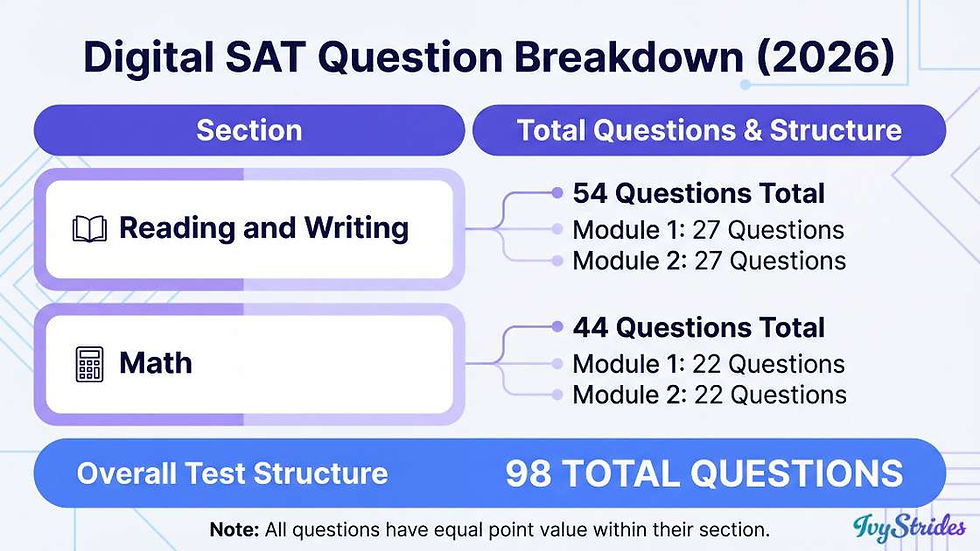
Reading and Writing | 2 | 32 min | 64 min | 54 | 27 | About 71 seconds |
Break | n/a | n/a | 10 min | n/a | n/a | n/a |
Math | 2 | 35 min | 70 min | 44 | 22 | About 95 seconds |
Total | 4 | n/a | 134 min (2 hr 14 min) | 98 | n/a | Varies by section |
Section times and totals per the College Board SAT structure page, verified 8 August 2026. The per-module question counts (27 and 22) come from the Assessment Framework for the Digital SAT Suite; the structure page publishes only the section totals of 54 and 44. Those per-module counts hold for the standard adaptive form. Students testing on a linear paper accommodation form get a different split.
The two sections do not run at the same pace. College Board allows an average of 1.19 minutes per Reading and Writing question, about 71 seconds, but 1.59 minutes per Math question, about 95 seconds. A single pacing habit carried across both sections will not fit either one well.
Not every one of the SAT's 98 questions counts toward a score. Ninety do. The other 8 are unscored pretest questions, 2 per module, and nothing marks them out, so answer all 98 as though every one counts.
College Board publishes the per-module figures. IvyStrides sums them to 90 scored and 8 unscored.
A pacing gap of 71 seconds against 95 seconds looks small written down. To feel what it does to a module, time a real full-length test rather than working through a loose question set.
Module
A module is one separately timed block of questions with its own countdown. Every SAT section contains two modules of equal length, and a student moves from the first straight into the second with no pause between them.
The Reading and Writing section covers Information and Ideas, Craft and Structure, Expression of Ideas, and Standard English Conventions. Its passages and passage pairs run 25 to 150 words and carry one question each. Texts that short make an average of about 71 seconds per question workable.
Math covers Algebra, Advanced Math, Problem-Solving and Data Analysis, and Geometry and Trigonometry. You get a calculator on every Math question, either the Desmos calculator built into Bluebook or your own approved handheld. Reading and Writing allows no calculator. The old no-calculator Math section is gone.
How Many Breaks Does the SAT Have?
The digital SAT has one 10-minute break, between the two sections.

Why some schedules show more than one break
College Board's current materials list a single scheduled 10-minute break, between the Reading and Writing section and the Math section. Schedules showing more breaks describe either accommodated testing or the retired pre-2024 paper SAT, which College Board no longer documents.|| College Board retired the old paper format as the standard test in spring 2024, though it still administers a paper version to students approved for a paper-based accommodation.
Bluebook starts the break automatically, and you cannot start it early or cut it short. The 10 minutes are fixed, so you cannot trade them for extra working time.
Allowed during the break: use the restroom, and eat a snack or drink water in the designated break areas. You may take your snack and drink with you when you leave the room.
Not allowed during the break: your phone or any other device, discussing test questions, or opening study materials.
How staff enforce the device rule: proctors and other test center staff either collect phones or require you to stow them in a bag away from your desk. Phones stay off-limits for the whole administration, break included.
Mid-module restroom trips: the clock does not stop. Time away from your desk during a module still runs on the module clock. Only one accommodation stops it: breaks as needed gives the student a pause button, and that break time does not count as testing time. Extra breaks and extended breaks fall between modules, so neither protects a mid-module absence.
Break structure and test-day device rules per College Board, what to expect on test day.
What Time Does the SAT Start and End?
College Board schedules SAT testing to start between 8:15 and 8:30 a.m. Its published schedule ends standard-time testing between 10:45 and 11:00 a.m. Doors open at 7:45 a.m. and close at 8:00 a.m., so 8:00 is the deadline to be inside the test center, not the moment testing begins.

Why an 8:00 a.m. start time is the wrong number to plan from
Doors close at 8:00 a.m. That is not when the test starts: testing begins between 8:15 and 8:30 a.m., after check-in, seating and proctor instructions. Plan your day from an 8:00 a.m. start and your finish estimate lands roughly half an hour too early. That is how people end up waiting in the parking lot.
The full SAT test day clock
SAT test day clock, 8:15 a.m. and 8:30 a.m. starts
Stage | 8:15 a.m. start | 8:30 a.m. start |
Doors open, check-in begins | 7:45 a.m. | 7:45 a.m. |
Doors close. College Board admits no one once testing has started, so treat 8:00 as the hard deadline. Miss it and you register again and pay the standard fee | 8:00 a.m. | 8:00 a.m. |
Seating, proctor instructions, device setup | 8:00 to 8:15 a.m. | 8:00 to 8:30 a.m. |
Reading and Writing Module 1 | 8:15 to 8:47 a.m. | 8:30 to 9:02 a.m. |
Reading and Writing Module 2 | 8:47 to 9:19 a.m. | 9:02 to 9:34 a.m. |
Break (10 minutes) | 9:19 to 9:29 a.m. | 9:34 to 9:44 a.m. |
Math Module 1 | 9:29 to 10:04 a.m. | 9:44 to 10:19 a.m. |
Math Module 2 | 10:04 to 10:39 a.m. | 10:19 to 10:54 a.m. |
Testing ends on our chained module clock (College Board publishes 10:45 to 11:00 a.m., reconciled in the note below) | About 10:39 a.m. | About 10:54 a.m. |
Dismissal, once the proctor collects scratch paper | A few minutes later | A few minutes later |
Check-in times and the 10:45 to 11:00 a.m. end-of-testing window per College Board, what to expect on test day. Module lengths per the SAT structure page. IvyStrides builds the module clock in this table by chaining College Board's published module lengths from each end of its 8:15 to 8:30 a.m. start window. That chain ends about 6 minutes before College Board's published end-of-testing window, because untimed transitions between modules are not published. College Board also notes that arrival times may differ from its sample schedule, so treat this as a shape rather than a stopwatch. A printable version sits with the free SAT downloads. Before test day, check what to bring. If your test center is full, IvyStrides covers ways to still get a seat.
How long will my child be at the SAT? Drop-off and pickup
For parents: the drop-off and pickup window
Aim to drop your child off by 7:45 a.m., when test centers open and check-in begins. College Board's cutoff is 8:00 a.m., when doors close, and it admits no one once testing has started, so treat 7:45 as the target rather than the edge. Check the admission ticket, because some centers set different arrival times.|| Block out 3 to 3.5 hours from the 7:45 a.m. check-in. We reach that by running the clock to College Board's published 10:45 to 11:00 a.m. end of standard-time testing and adding a few minutes for dismissal.
The test-day window is one piece of a longer prep timeline. IvyStrides maps the rest for parents in a parent's guide to the digital SAT and in how to support your child's SAT prep.
Testing starts between 8:15 and 8:30 a.m. local time, once the room finishes check-in. Arrival times can differ from the standard schedule, so check your admission ticket for your test center's time.
One SAT structure runs worldwide, with no separate international version. Some countries differ on the day rather than the hour: India and Pakistan offer Sunday testing. IvyStrides has a fuller guide to testing from outside the US.
If your school says SAT School Day takes about 3 hours, the figure holds up. College Board publishes no test-day timeline for School Day. Its weekend schedule already spans about 3 hours, from the published 7:45 a.m. check-in to the 10:45 to 11:00 a.m. end of standard-time testing. Schools then add their own homeroom, check-in and dismissal on top of that.
The School Day test itself runs the same 2 hours 14 minutes of testing as the weekend SAT, with the same 98 questions and the same single break. One exception: the state-required Essay adds 50 minutes in the states that require it.
How Long Is the SAT With Extended Time?
With time and a half (50% extended time) the SAT runs 3 hours 22 minutes of testing, and with double time (100% extended time) it runs 4 hours 28 minutes.

College Board publishes extended time as per-section minutes rather than as one multiplier across the whole sitting, and its Math figure implies it applies the extension module by module: 35 minutes at time and one-half rounds up to 53, so Math comes to 106 rather than 105.
Reading and Writing runs 64 minutes under standard timing, 96 minutes at time and a half and 128 minutes at double time. Math runs longer at every tier: 70 minutes standard, 106 at time and a half and 140 at double time.
SAT length with standard, 50% and 100% extended time
Timing | Reading and Writing | Math | Testing time | Scheduled breaks | Testing ends |
Standard | 64 min | 70 min | 2 hr 14 min | 10 min | 10:45 to 11:00 a.m. |
50% (time and a half) | 96 min | 106 min | 3 hr 22 min | 20 min | Noon to 12:15 p.m. |
100% (double time) | 128 min | 140 min | 4 hr 28 min | 20 min | 1:00 to 1:15 p.m. |
Why extended time comes with 20 minutes of breaks
Extended time on the SAT automatically brings extra breaks. College Board adds two 5-minute breaks to the standard 10-minute one, so an extended-time student gets 20 minutes of scheduled breaks rather than 10.|| Break time does not count as testing time, which is why an extended-time student stays on site longer than the testing-time column alone suggests.
College Board publishes 3 hours 22 minutes directly as the SAT testing time for up to 50% extended time (96 minutes Reading and Writing, 106 minutes Math), per College Board accommodations. College Board's own SAT accommodations page gives 3 hours 21 minutes instead. The difference is where the rounding falls: 3:21 rounds at the section level (96 plus 105), while 3:22 rounds at the module level, since 35 minutes times 1.5 rounds up to 53 per module. We use 3:22 because it matches the per-section figures College Board publishes. College Board does not explain the discrepancy. End-of-testing windows per College Board, what to expect on test day.
This rule changed in Spring 2025
Since spring 2025, students testing with extended time can move on to the next part of the test once the standard testing time for that part has passed, rather than waiting out their full extended time. English learners approved for up to time and one-half are covered by the same rule.|| Break time is the exception: students approved for extended time receive extra breaks and cannot end break time early, so the early-release rule applies to test modules only.
Early-release rule per College Board SSD updates. Break rule per the College Board Accommodations and Supports Handbook, Fall 2026 edition.
Most students approved for up to double time test in a single day. Multi-day testing is not simply a matter of exceeding double time: College Board schedules two days when the approved testing time will not fit into one.
The Limited Time accommodation triggers that by definition, and some up-to-double-time approvals, such as double time for reading, also do. Needing more than one day is itself one of the reasons College Board classifies an accommodation as school-based, rather than a result of that classification.
Where accommodations overlap, College Board says the student uses the one giving the greater testing time rather than adding them together.
On the SAT, extended time already includes extra breaks, so the two do not stack. For the fuller walkthrough, see our guide to the SAT with time and a half.
How to request extended time on the SAT
SSD
Services for Students with Disabilities (SSD) is the College Board office that reviews and approves testing accommodations. Every extended-time approval on the SAT comes from it.
Requests go through your school SSD coordinator via SSD Online. Most students with an existing IEP or 504 plan are approved on that submission alone, usually within about a week.
College Board requests documentation only in some cases. Where it does, it says review can take up to seven weeks, and that clock starts only once it holds everything it asked for. Ask for more and you add up to another seven weeks. Approvals granted fewer than 14 days before test day may not be in place for that administration.
With limited exceptions, an approval then carries across College Board tests and lasts until one year after high school graduation, though each test can deliver it differently. Extended time does not bring extra breaks on AP the way it does on the SAT, so do not assume one test behaves like another.
Request process per College Board, requesting accommodations.
Is the SAT Timed? SAT Time Limits Inside Bluebook
Yes, the SAT is timed, and every one of the 4 modules runs its own countdown inside Bluebook, the College Board app that delivers the test. The rules below cover both standard timing and extended time. A student who finds the countdown distracting can hide it, though Bluebook brings the timer back with an alert when 5 minutes remain.
SAT time limits: four rules that catch families off guard
Time never transfers between modules. Most students have none to transfer anyway, because Bluebook will not let them move on or submit early.
Mark for Review and the question menu let you move back and forth between questions inside a module until time expires. Once you leave a module you cannot return to it.
A standard-time student has to keep their device on and stay logged in to Bluebook until the standard testing time is up.
Since spring 2025, extended-time students no longer sit out the remainder of their extension once standard time for a part has elapsed.
Timer behavior per Bluebook testing tools. Module and early-finish rules per Bluebook, can I finish the test early and Bluebook timing.
A standard-time student who works through the questions quickly still cannot leave a module early. Bluebook submits answers automatically at the end of testing, and a student can leave the room only after the proctor confirms that submission and dismisses them.
How the Digital SAT Adaptive Format Changes Your Timing
Adaptive difficulty does not change how long the SAT takes: module 2 is still 32 minutes in Reading and Writing and 35 minutes in Math. The harder second-stage module carries the same allotment as the easier one, because performance on module 1 sets difficulty and not the countdown.
Multistage adaptive testing
College Board builds the digital SAT as a multistage adaptive test: each section runs as two separately timed modules, and the second adapts to how you did on the first. The two sections route independently, so your Reading and Writing result does not affect which Math module you get. Harder or easier, that second-stage module keeps the same question count and the same time limit.
A student who finds the second Reading and Writing module noticeably harder still has 32 minutes for 27 questions, exactly what the easier version gives. The harder second Math module still runs 35 minutes for 22 questions. Difficulty rises; the allotment does not. See how the routing decides which module you get for the mechanism behind that.
Time does not roll from a section's first module into the second. Whatever you leave unused expires with the module, so pace each one to leave a buffer inside it.
That settles timing, not scoring. For what a harder second module does to your score, read how the digital SAT is scored and whether module 1 locks in your score ceiling.
SAT Pacing Checkpoints: Where You Should Be at Each Minute
On an SAT Reading and Writing module, have question 7 answered by the 8-minute mark, question 14 by 16 minutes and question 20 by 22 minutes. On an SAT Math module, answer question 6 by 9 minutes, question 11 by 16 minutes and question 17 by 25 minutes.

SAT pacing checkpoints by module
Module | Quarter mark | Half mark | Three-quarter mark | Reserve |
Reading and Writing (32 min, 27 questions) | Question 7 answered by 8 minutes | Question 14 by 16 minutes | Question 20 by 22 minutes | Hold the last 2 minutes for marked questions |
Math (35 min, 22 questions) | Question 6 answered by 9 minutes | Question 11 by 16 minutes | Question 17 by 25 minutes | Hold the last 3 minutes for marked questions |
IvyStrides builds these checkpoints from College Board's published module lengths and question counts. We derive them rather than survey students for them, and the reserve sits inside the calculation rather than bolted on afterwards, so hitting a checkpoint already banks the buffer. College Board's own published guidance is coarser: after about 10 minutes you should have completed around 8 or 9 Reading and Writing questions, or 6 or 7 Math questions. Reading and Writing gives 32 minutes for 27 questions. Holding 2 minutes back leaves 30 working minutes, about 67 seconds per question, so the quarter mark falls at 8 minutes and question 7. Math gives 35 minutes for 22 questions. Holding 3 minutes back leaves 32 working minutes, about 87 seconds per question. Those working paces run slightly ahead of the raw 71 and 95 second averages, which is the point: you earn the reserve during the module rather than discover it at the end.
College Board publishes one pacing marker: after about 10 minutes you should have completed around 8 or 9 Reading and Writing questions, or 6 or 7 Math questions. That marker lands early, while the table above spaces three checkpoints across the whole module.
A student sits four modules back to back with a single 10-minute break in the middle, which is why 2 hours 14 minutes of testing can feel longer than it is. The digital SAT is shorter than the paper test but not denser: College Board's own paper-versus-digital specifications allow 1.37 minutes per question on the digital test and 1.17 on paper.
When students say the second Math module is where the test got away from them, the cause is stamina and adaptive difficulty rather than a faster clock: that module runs on the same 35 minutes as the one before it. IvyStrides covers ways to steady that before test day.
The checkpoint table above only works against a running clock: a full-length timed sitting, not a question set. A full-length Bluebook practice test keeps the same four-module structure and the same time allotments as the real SAT. Sit one, or one of the IvyStrides SAT practice tests, then mark which question you had answered at minute 16.
Minute 16 is the one checkpoint the table gives for both Reading and Writing and Math, which makes it usable whichever module you are sitting. College Board flags one difference between practice and test day: in practice mode you can move forward before time expires, so a practice sitting can finish sooner than a real one.
Two things cause a missed checkpoint. A pacing gap means you knew the material but ran out of clock; a content gap means more minutes would not have helped. Each needs its own plan. Telling them apart takes a structured review of your mistakes rather than another sitting, and before you schedule more, see how many practice tests are worth taking.
A pacing gap shows up in one timed test, but a content gap does not.
If the clock is the problem, live online SAT coaching works pacing directly against timed modules. Content gaps need a different fix, and how to study for the SAT lays out the method. From there, a 30-day SAT study plan turns it into a schedule.
How Long Was the Old Paper SAT? What the 2024 Switch Changed
The paper SAT ran 3 hours and the digital SAT runs 2 hours 14 minutes of testing, so the digital test is roughly 45 minutes shorter. College Board frames the change as a move from 3 hours to just over 2 hours of testing and publishes no minute figure, so the 45-minute difference is ours.
Is the SAT 3 hours long? No. Three hours was the paper test, and the 9 March 2024 administration completed the move to digital in the US, retiring that format as the standard SAT.
That difference is not trivia: pacing advice written for the paper SAT no longer transfers, because the paper test had a separate no-calculator math section and long reading passages with many questions each. An older sibling who says the test is three hours took a different test.
Does the SAT still have an Essay, and does it add extra time?
The weekend SAT has no Essay, so the testing time stays at 2 hours 14 minutes. College Board discontinued the optional Essay after the June 2021 administration.
Certain states still require an Essay for SAT School Day, and students testing in those states get 50 minutes for it on top of their testing time. Individual states set that requirement, not College Board, so ask your school counselor whether your School Day administration includes the Essay.
Essay availability and the 50-minute allotment per College Board, SAT School Day Essay.
SAT vs ACT vs PSAT: Which Test Takes the Longest?
The SAT is about 9 minutes longer than the shortest ACT option, and shorter than every other ACT configuration. Saying flatly that the SAT is shorter than the ACT is misleading, because it depends which ACT you sit. Both figures are testing time and exclude breaks.


SAT, ACT and PSAT length compared
Sections | Testing time | |
SAT | Reading and Writing, Math | 2 hr 14 min |
ACT | English, Math, Reading | 2 hr 5 min |
ACT + Science | English, Math, Reading, Science | 2 hr 45 min |
ACT + Writing | English, Math, Reading, Writing | 2 hr 45 min |
ACT + Science and Writing | English, Math, Reading, Science, Writing | 3 hr 25 min |
PSAT/NMSQT, PSAT 10, PSAT 8/9 | Reading and Writing, Math | 2 hr 14 min |
ACT section times per act.org. ACT publishes the 2 hr 45 min figure itself, on its test day page. ACT publishes no total for the other three configurations, so we sum its published per-section minutes: 2 hr 5 min for English, Math and Reading, 2 hr 45 min for that trio plus Writing, and 3 hr 25 min for all five sections. The 2 hr 55 min length still in circulation describes the pre-2025 ACT and no longer matches the current test. It survives on an old ACT newsroom page the organization has not taken down.
Note that two different ACT configurations both take 2 hours 45 minutes, so "the 2:45 ACT" is ambiguous unless you say which sections it includes. If the ACT is the better fit, our Enhanced ACT prep is built for the shorter format. There is a fuller breakdown in the Enhanced ACT format and timing and in what changed in the Enhanced ACT.
All three PSATs run the same 2 hours 14 minutes as the SAT across the same four modules, which surprises most students who expect a shorter test. The equal length means every pacing checkpoint above transfers straight to the PSAT.
That overlap is why PSAT prep doubles as early groundwork for the SAT. See the digital PSAT format and PSAT 8/9 vs PSAT 10 vs PSAT/NMSQT.
Timing settles one question and leaves the other open. These figures tell a family how long to block out for either test. They cannot tell a student which test to take. That choice deserves more room than a timing article gives it, so IvyStrides keeps the full ACT versus SAT comparison on a page of its own.
Frequently Asked Questions About SAT Timing and Duration
How long is the SAT?
College Board gives the digital SAT 2 hours 14 minutes of testing time. The single 10-minute break pushes the total to 2 hours 24 minutes. Add check-in and dismissal, and plan on about 3 to 3.5 hours at the test center.
How many hours is the SAT?
The digital SAT takes 2 hours 14 minutes of testing, or 2 hours 24 minutes from the first module to the last. Add check-in and dismissal on either end, and the visit to the test center runs about 3 to 3.5 hours.
What is the SAT time limit for each module?
Bluebook enforces a 32-minute limit on each Reading and Writing module and a 35-minute limit on each Math module. Every module clock runs separately, and the app moves you on the moment a timer reaches zero.
How long is the SAT with breaks?
College Board publishes 2 hours 14 minutes of testing plus one 10-minute break, but never the total. Sum them and you get 2 hours 24 minutes, or 144 minutes, from the first module to the last. Its own test-day schedule allows roughly 2 hours 30 minutes, because Bluebook shows untimed transition screens between modules.
How long are you at the SAT test center?
Most students spend about 3 to 3.5 hours at the test center. Doors open at 7:45 a.m. and close at 8:00 a.m., and testing starts between 8:15 and 8:30 a.m. College Board schedules standard-time testing to end between 10:45 and 11:00 a.m., and proctors dismiss students after that.
Is the SAT 3 hours long?
No. Three hours was the old paper SAT. The digital SAT is 2 hours 14 minutes of testing, roughly 45 minutes shorter, and the transition to digital finished in March 2024.
Is the SAT timed?
Yes. Bluebook times all 4 modules separately and shows a countdown for the module you are in. Time never transfers between modules, and most students have none to spare anyway. Bluebook blocks moving on or submitting early, so they sit until the clock expires. Extended-time students have been the exception since spring 2025.
How long is each section of the SAT?
The SAT gives Reading and Writing 64 minutes and Math 70 minutes. Those add up to 134 minutes of testing. A single 10-minute break falls between the two sections, so the run from the first module to the last comes to 144 minutes.
How long is each SAT module?
Each Reading and Writing module is 32 minutes and each Math module is 35 minutes. There are four modules in total, two per section, with no break between the two modules in a section.
How many questions are on the SAT?
The SAT has 98 questions: 54 in Reading and Writing (27 per module) and 44 in Math (22 per module). Of those, 90 are scored and 8 are unscored pretest questions.
How much time do you get per question on the SAT?
About 71 seconds per question on Reading and Writing and about 95 seconds on Math. College Board publishes these as per-section averages, 1.19 and 1.59 minutes, and does not publish a single blended figure.
What time does the SAT start and end?
Doors open at 7:45 a.m. and close at 8:00 a.m., and testing usually begins between 8:15 and 8:30 a.m. College Board lists standard-time testing as ending between 10:45 and 11:00 a.m., and proctors then dismiss students individually, so the exact minute varies by room.
How many breaks does the SAT have?
One. A single 10-minute break sits between the Reading and Writing section and the Math section. Any schedule showing more than that is either describing accommodated testing or quoting the pre-2024 paper format.
Is there a break between SAT modules?
No, not under standard timing: the two modules inside each section run back to back. College Board adds a 5-minute between-module break for students approved for extra breaks. On the SAT and PSAT, extended time automatically carries those extra breaks with it.
How long is the SAT with time and a half?
Time and a half stretches the SAT to 3 hours 22 minutes of testing: 96 minutes for Reading and Writing, 106 for Math. Scheduled breaks add another 20 minutes, and College Board schedules testing to end between noon and 12:15 p.m.
How long is the SAT with double time?
Double time gives Reading and Writing 128 minutes and Math 140 minutes, for 4 hours 28 minutes of testing in all. Twenty minutes of scheduled breaks sit on top of that. College Board schedules testing to end between 1:00 and 1:15 p.m.
What time does the SAT end with extended time?
College Board publishes two end-of-testing windows: noon to 12:15 p.m. with time and a half, and 1:00 to 1:15 p.m. with double time. Extra break accommodations push both later.
Do you have to stay the whole time with extended time on the SAT?
No, and this changed in spring 2025. Once the standard testing time for a part has passed, extended-time students can move on rather than waiting out the full extension. Break time is the exception: you still cannot cut it short.
Can you leave the SAT early if you finish?
Standard-time testers cannot advance past a module early, even with every question answered. Once Bluebook submits your full test and the proctor completes dismissal, you can leave.
Can you go back to previous questions on the digital SAT?
Yes, but only inside your current module. Bluebook lets you move back and forth across the questions in that module using Mark for Review and the question menu. Leaving a module closes it for good.
Does the SAT still have an essay?
No, not on the weekend SAT. The optional Essay ended with the June 2021 administration. Certain states still require one for SAT School Day, where it adds 50 minutes. Ask your school counselor whether your administration includes one.
When do SAT scores come out after the test?
College Board releases scores 13 days after test day on every published Fall 2026 weekend date. SAT School Day works differently. Scores follow a staggered schedule keyed to when your school submits answers, so early testers can see scores before the testing window closes. Ask your school which submission date it is using.
How long is SAT School Day?
SAT School Day matches the weekend SAT on structure and timing: 2 hours 14 minutes of testing, 98 questions, four modules and one 10-minute break. The state-required Essay adds 50 minutes where it applies. A 3-hour estimate fits too: the published schedule runs about 3 hours from check-in to the end of standard-time testing.
How long is a full-length SAT practice test?
A full-length Bluebook practice test uses the real SAT structure and time allotments: four modules, 64 minutes for Reading and Writing and 70 for Math. College Board flags one difference. In practice mode you can move forward before a timer expires, so a sitting can finish sooner than the real 2 hours 14 minutes.
How long will my child be at the SAT?
About 3 to 3.5 hours for standard timing. Aim to drop off by 7:45 a.m. when centers open, because doors close at 8:00 a.m. College Board schedules standard-time testing to end between 10:45 and 11:00 a.m. Add a few minutes for dismissal. Extended time runs later.
What time should I pick my child up from the SAT?
College Board schedules standard-time testing to end between 10:45 and 11:00 a.m., time and one-half between noon and 12:15 p.m., and double time between 1:00 and 1:15 p.m. The proctor then takes a few more minutes to dismiss the room, so aim for the later end of each window.
Your Next Step After the SAT Clock
You now have the SAT clock in one piece: 2 hours 14 minutes of testing, a single 10-minute break, and an end that College Board publishes as a window rather than a fixed minute. What you do with those numbers depends on why you went looking for them, so take the branch below that describes your situation.
If you came for the shape of test day, hold on to three things: doors close at 8:00 a.m., testing runs 2 hours 14 minutes, and College Board schedules standard-time testing to end between 10:45 and 11:00 a.m. That last one is a window, not a minute, so plan a pickup window rather than a pickup time.
If you do not yet know whether the clock or the content is costing you points, sit one full-length test under real module limits. Note which question you have answered at each quarter, half and three-quarter mark. Then read those marks against the SAT pacing checkpoint table above.
If you are approved for extended time, plan the day around a noon or 1:00 p.m. finish, not a 10:45 a.m. one.
If you are still waiting on an SSD decision, start the request now rather than in test week: documentation cases can take up to seven weeks, and approvals granted fewer than 14 days out may not apply to that administration.
If your child has not started yet, one timing question outranks every test-day minute on this page: when to start SAT prep.



Comments