

How to Raise your SAT Score 200 Points in 2026: A Step-by-Step Guide That Actually Works
- prabaram1
- Jul 30
- 13 min read

Yes, raising your SAT score by 200 points is realistic for most students below 1400. In our coaching, students who complete a full diagnostic, follow a targeted section-specific plan, and put in roughly 50 to 80 hours of structured practice over 8 to 12 weeks typically achieve gains in this range. The mechanism is not more practice tests. It is diagnosing exactly which question types cost you points, fixing those gaps systematically, and retesting to confirm the gains stuck.
The format claims in this guide reflect the current Digital SAT, verified against College Board documentation. What follows is the sequence itself: how to set a diagnostic baseline, where your points are actually hiding by section, how many weeks and hours a 200-point jump really takes, and when self-study stops being enough. Let's start with the honest question everyone asks first.
Is a 200-Point SAT Gain Actually Realistic for You?
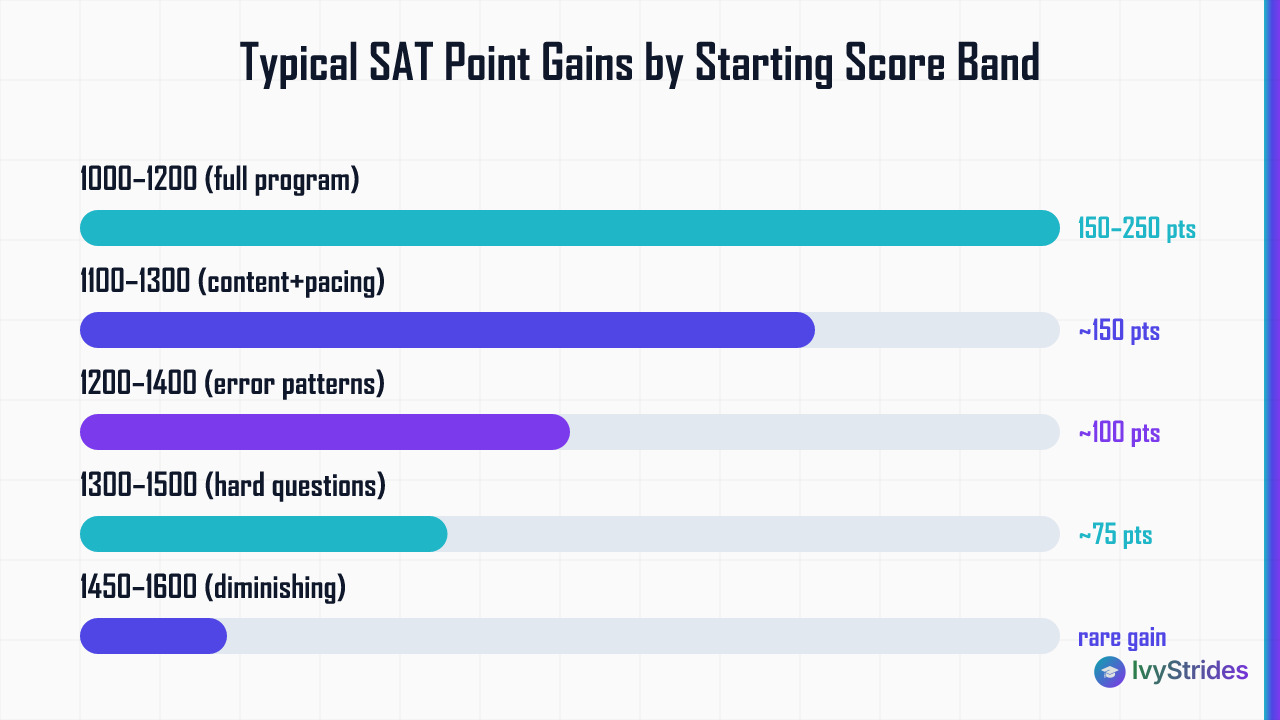
The short answer depends almost entirely on where you're starting. A 200-point gain from 1100 to 1300 moves a student from roughly the 57th to the 87th percentile on the Digital SAT's 400-1600 scale, a shift that meaningfully changes the list of colleges where a score is competitive. That's not a cosmetic bump. It's a different tier of applicant.
Here's how the score bands actually behave. Students in the 900-1100 band have foundational content gaps, which sounds discouraging but is good news: those gaps are the easiest points to recover. In our coaching, students at the 1000-1200 band who complete the full program typically see gains of roughly 150 to 250 points, because closing basic algebra and grammar holes moves the needle fast. The 1100-1300 band is a mix of content gaps and pacing errors. The 1200-1400 band is mostly error-pattern elimination and adaptive-module strategy. And the 1300-1500 band is about Module 2 hard-question accuracy and near-zero careless mistakes.
Now the honest ceiling. Students already above 1450 face real diminishing returns. A 200-point gain from 1450 to 1600 is rare and requires near-perfect execution across both sections, because at that level you have almost no error budget left to reclaim. So how many points can you realistically raise your SAT score? It comes down to three variables: your starting score, the hours you invest, and whether that prep is targeted at your specific weaknesses or just generic volume. Before you lock in a target, it helps to understand what score ranges actually mean for admissions; our breakdown of what counts as a good SAT score in 2026 puts percentiles and college benchmarks in plain language. Our SAT score scale explainer shows how the two section scores combine.
Step 1: Take a Real Diagnostic Test and Set a Realistic Target Score
You cannot build a 200-point plan on a guess. The first move, before any drilling, is a full-length official Digital SAT practice test taken under real conditions. Timed. One sitting. Both sections. No pausing to look up an answer.
College Board provides free full-length Digital SAT practice tests inside the Bluebook app, the same app you'll use on test day. This matters more than most students realize. A section drill or an untimed quiz tells you almost nothing about your real score, because it strips out the two things the Digital SAT actually tests: pacing under pressure and stamina across two adaptive modules. Take the whole thing.
Your diagnostic baseline comes back as two section scores, Reading and Writing (R&W) and Math, each on a 200-800 scale, adding to your 400-1600 total. This split is the single most useful piece of diagnostic information you'll get. Knowing which section carries the larger gap tells you where to invest first. A student sitting at 1180 with a 550 R&W and a 630 Math should pour early hours into R&W, not spread effort evenly.
Set your target score against the 25th-to-75th percentile range at your actual target colleges. You can find those ranges by searching "Common Data Set" plus the university name; each school publishes its own admitted-student score distribution. Aim for around the 75th percentile of your top-choice schools if you want your score to be an asset. For a broader overview of Digital SAT mechanics, adaptive difficulty, and full-year planning, the official SAT study guide 2026 is the companion resource to bookmark alongside this article. When you're ready to schedule regular timed sittings, our library of official SAT practice tests gives you the retesting cadence a 200-point plan needs.
Why Your Score Might Not Be Moving Yet (and How to Fix It)
This is the wall most students hit. You've taken three practice tests, put in the hours, and your score is stuck within 20 points of where it started. Frustrating. And almost always fixable.
The reason is simple: retaking practice tests without reviewing your errors produces stagnation, not growth. Taking a test measures your score. It doesn't raise it. The raising happens in what you do with the wrong answers. In our coaching, students who add a structured mistake log after each practice test see faster gains than those who only retest without review. A mistake log isn't fancy. For every question you missed, you write down the question type, why you missed it, and the correct reasoning. Patterns surface within two tests.
Then there's the adaptive-module trap. The Digital SAT's structure means your performance on Module 1 determines whether Module 2 serves you easier or harder questions. A student who scores well on R&W Module 1 will face a harder Module 2, and if you've only ever practiced average-difficulty questions, you plateau there because you never built the accuracy to handle hard items. This is why generic prep fails at the higher bands.
The error patterns themselves are predictable. In R&W, students routinely misread the question stem on Craft and Structure items, answering what they assumed the question asked rather than what it actually asked. They also rush Standard English Conventions questions and make careless comma and agreement errors on points they clearly know. In Math, two patterns show up most often: skipping Problem-Solving and Data Analysis questions because the setup looks unfamiliar, and burning three or four minutes on a single Advanced Math multi-step problem, which starves the rest of the module of time.
If you've already been studying for several weeks and your score has stopped moving, the tactics in our guide on how to break an SAT score plateau explain exactly why gains stall and how to restart momentum. To set up the tracking system itself, grab our SAT mistake tracker and start logging after your next full-length test.
Not Sure Why Your Score Has Stalled?
Book a free 15-minute strategy call. An IvyStrides section-specialist will review your diagnostic results, identify your highest-impact error patterns, and recommend the exact next step for your score band. Parents welcome on the call.
Section-by-Section Strategy: Where Your 200 Points Are Hiding
Half your total score lives in Math and half in R&W, so a 200-point gain has to come from somewhere specific. Here's where.
Reading and Writing is 54 questions in 64 minutes across two modules, per College Board format. The section covers four question-type categories: Information and Ideas, Craft and Structure, Expression of Ideas, and Standard English Conventions. Of these, Standard English Conventions is the highest-volume, fastest-to-fix category for students in the 1100-1300 band. Comma rules, subject-verb agreement, and pronoun reference are learnable in a weekend and then reliable forever. In our coaching, mastering this single category can add roughly 20 to 40 points to R&W on its own. That's a meaningful chunk of your 200 sitting in the most learnable question type on the test.
For the reading-heavy question types, use the 30-second main-idea shortcut: on purpose and main-idea questions, read the final sentence of the passage first, then confirm with the opening sentence, before you read the full thing. You'll know what you're looking for before you start, which stops you from re-reading. For a full treatment of the reading side, our guide on how to improve SAT reading score walks through each R&W category with drills.
SAT Math is 44 questions in 70 minutes across two modules, calculator permitted on all questions, and it covers Algebra, Advanced Math, Problem-Solving and Data Analysis, and Geometry and Trigonometry, per College Board. Algebra and Advanced Math together account for roughly 55 to 60 percent of Math questions. So if you're in the 1200-1400 band and you haven't drilled linear equations, systems, and quadratics until they're automatic, that is where your points are hiding. Not geometry. Not the exotic-looking stuff. The high-frequency algebra.
The pacing rule that saves Math scores: spend no more than 90 seconds on any Module 1 question. Flag it, move on, come back. Burning three minutes on one hard question costs you the two easier questions at the end that you'd have answered correctly. Because Math accounts for half your total score, students targeting a 200-point gain almost always need a dedicated Math plan; our SAT Math prep guide covers every topic category and the fastest ways to close gaps. For a deeper category-by-category map, see our breakdown of SAT Math topics. If you want expert eyes on your specific error patterns, an online SAT Math tutor can compress weeks of trial and error into a few focused sessions.
Your Week-by-Week Study Timeline for a 200-Point Gain
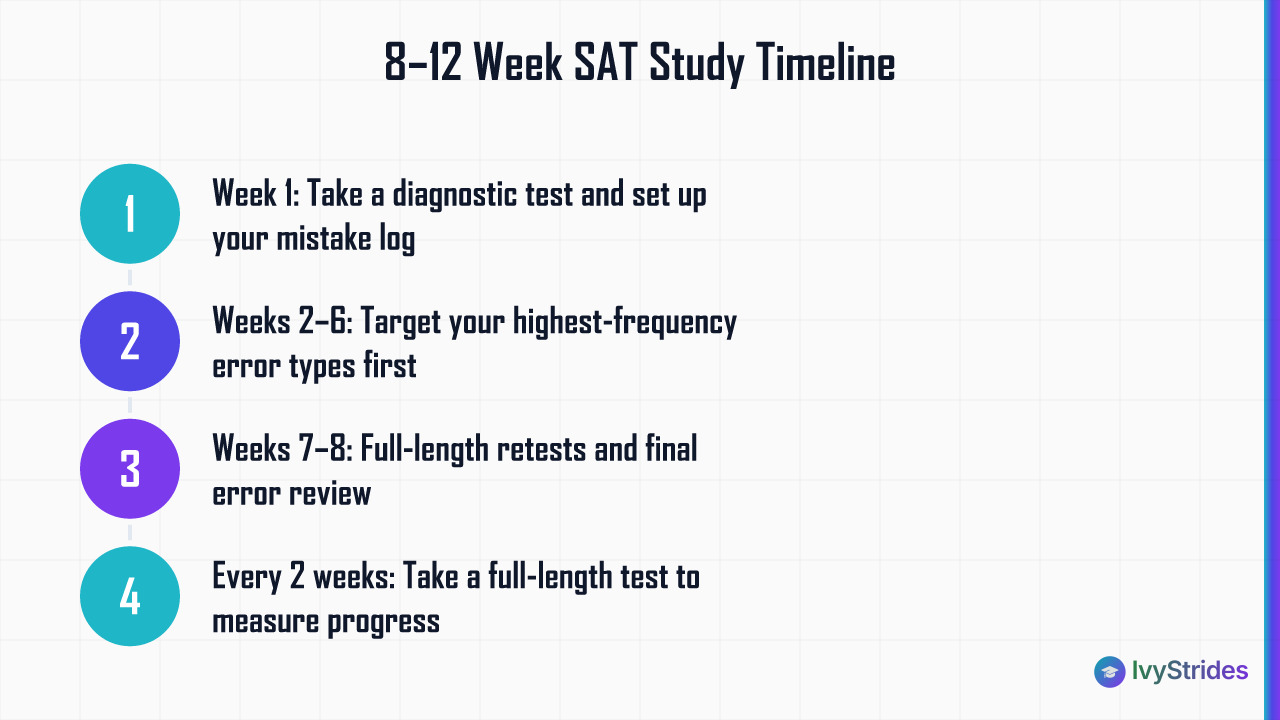
The math on effort is straightforward. A 200-point gain in 8 to 12 weeks takes about 6 to 8 hours per week of focused, structured practice, which works out to roughly 50 to 80 hours total. That's the sweet spot for most students: enough runway to fix patterns without cramming.
Here's how the three common timelines break down.
The 8-to-12-week plan. Week 1 is your diagnostic full-length test plus mistake-log setup. Weeks 2 through 6 are targeted section work, hitting your highest-frequency error types first. Weeks 7 and 8 are full-length retests and final error review. Take one full-length practice test every two weeks so you're measuring progress without over-testing. This is the plan we recommend when a student has the time, because it's the least stressful and the most reliable.
The 4-week plan. This requires roughly 12 to 15 hours per week, about double the intensity. It's possible for students who already have a solid baseline and clearly identified error patterns, but it's high-risk without structure and it isn't typical. Run one full-length test per week here, with the days in between spent on concentrated drilling of your two or three worst question types. No time for scattershot studying.
The 2-week question. Can you gain 200 points in two weeks? For most students, no. It's not realistic, and we won't pretend otherwise. What is realistic in two weeks is protecting the points you already have and squeezing out the careless-error gains. If your test date is that close, pair this plan with our last-minute SAT tips to lock in what you've earned rather than chasing a jump that won't materialize.
Pick your target test date with room to breathe. Our overview of SAT test 2026 dates and format helps you back-calculate: if you want 10 weeks of prep, count backward from the registration deadline and choose accordingly. For the full picture of how we structure prep around each timeline, see our SAT prep overview.
How Many Points Can You Realistically Raise Your SAT Score?
Let's put honest numbers on the full range, band by band, because "it depends" isn't an answer you can plan around.
Students starting at 900-1100: a 200-to-300-point gain is realistic with roughly 60 to 80 hours of targeted work. Foundational content gaps are the primary driver here, and closing them produces the largest jumps on the whole scale. You have the most room and the fastest wins.
Students starting at 1100-1300: a 150-to-250-point gain is typical in our coaching for students completing the full program. This band is a mix of content and pacing, so the plan splits between fixing specific weak categories and tightening timing.
Students starting at 1300-1400: expect roughly a 100-to-200-point gain. Gains at this level come from Module 2 hard-question mastery and driving careless errors to near zero. In our coaching with students targeting 1400 and above, the most common gap is not foundational content at all; it's accuracy on the hard Module 2 questions in both R&W and Math.
Students starting at 1450 and up: a 100-point gain is achievable but demands very high precision, and a 200-point gain to a perfect 1600 is rare. At that altitude, one careless mistake per section can be the difference.
If your goal is smaller, a 100-point gain follows the same method with a shorter timeline, usually about four to six weeks of targeted work. The process doesn't change; the volume does. A note on strategy: knowing how many times can you take the SAT matters here, because superscoring across sittings can compound your section gains. For target-setting, our guide to a good SAT score 2026 helps you decide how high you actually need to go. Whatever the number, we frame it the same way: these are typical outcomes for students completing the program, not guarantees. Nobody can promise you a specific score.
When Self-Study Is Enough and When You Need a Specialist Coach
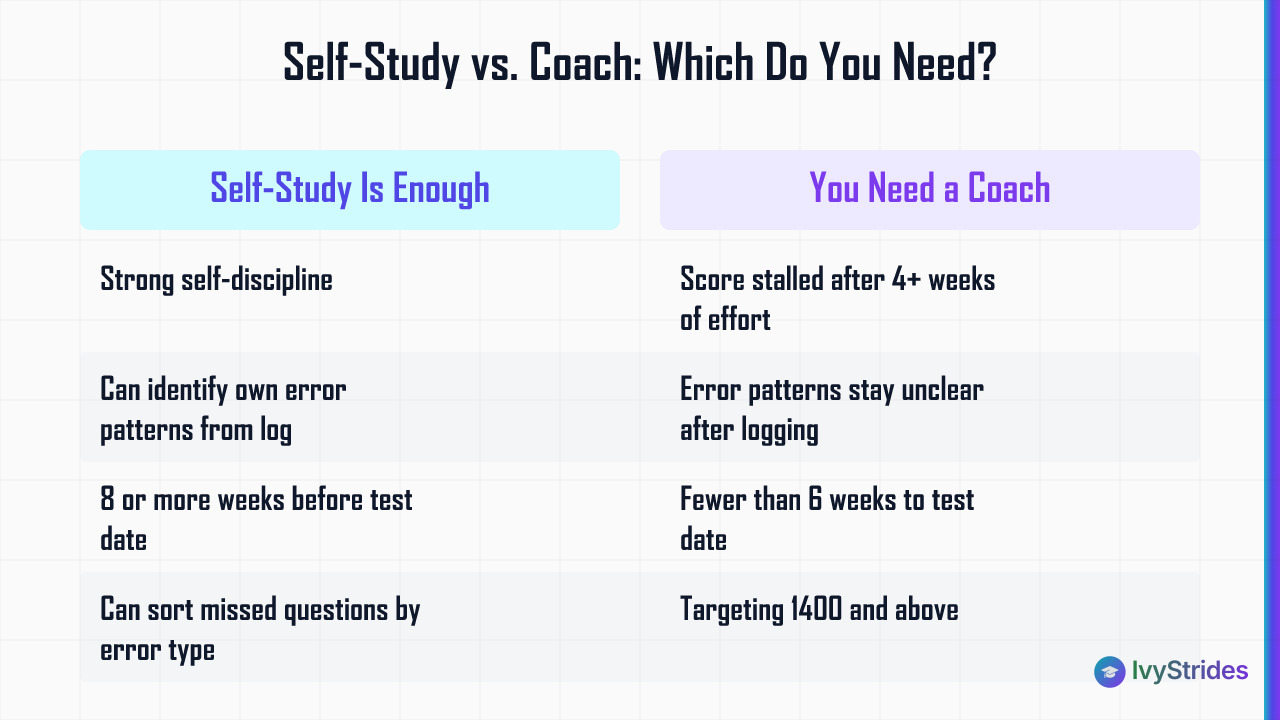
Not everyone needs a coach. Be honest with yourself about which category you're in.
Self-study is enough if you have strong self-discipline, you can identify your own error patterns from a mistake log, and you have eight or more weeks before your test date. If you can look at ten missed questions and correctly sort them into "didn't know the content," "misread the question," and "ran out of time," you have the diagnostic skill to run your own plan. Follow the steps above and you'll get there.
You likely need a coach if your score has stalled after four or more weeks despite consistent effort, if your error patterns stay unclear even after logging them, if you have fewer than six weeks to your test date, or if you're targeting 1400 and above. Here's the pattern we see: students who come to IvyStrides after a self-study plateau have typically been practicing for four to eight weeks without a structured error-analysis process, and the first session is almost always a diagnostic reframe, not new content. They didn't need more information. They needed someone to see the pattern they couldn't see.
The distinction that matters is section-specialist versus generalist. A section-specialist coach for SAT Math focuses exclusively on the four Math question-type categories and the adaptive module structure, so they recognize a Problem-Solving and Data Analysis error pattern in seconds. A generalist covers everything at surface level. Students targeting scores above 1400 benefit most from specialists, because the error patterns at that level are subtle and require expert identification. You can read more about our approach on our About page. You can also meet the tutors who coach at each score band.
Our 1-on-1 SAT prep is built around exactly this: diagnostic-driven plans, section-specialist coaches for R&W and Math, and a documented methodology of targeted weakness work plus spaced retesting. If you want a low-commitment first look, start with a free 30-min SAT consultation. For students juggling a heavy course load, our guide to online SAT prep for busy students shows how to fit the hours in without burning out.
Test Day and Registration: Locking In Your Plan
A great plan means nothing if you miss the registration window. Register for the SAT at least four to five weeks before your test date to avoid late fees and test-center availability problems; deadlines and seat availability are published on the College Board registration page and shift each year, so check current dates. Our walkthrough on SAT test registration covers the process step by step.
On test day, the Digital SAT runs through the Bluebook app on a school-provided or personal device. No paper booklets, no bubble sheets. Bring an approved device if you're using your own, your admission ticket, and acceptable ID. That's the short list.
Use a digital SAT calculator tool to model your target as you go. Plug in how many additional correct answers per section you need, and you'll see exactly how a handful of recovered questions in Standard English Conventions or Algebra translates into your target score delta. It makes the 200 points concrete instead of abstract.
One caveat worth keeping in front of you. Test-optional policies vary by school and by year, and you can track current policies at FairTest. Even at a test-optional school, a strong SAT score adds value because it can strengthen a borderline application. And remember that admissions decisions rest on the full application, not the SAT alone; a great score is a lever, not the whole machine. If you're planning ahead for a full season of prep, SAT winter batch enrollment opens the door to a structured multi-week plan with a clear test-date target.
FAQ
Is it possible to raise your SAT score by 200 points?
Yes, for most students below 1400, a 200-point gain is achievable. In our coaching, students who complete a full diagnostic, follow a targeted plan, and invest roughly 50 to 80 hours of structured practice over 8 to 12 weeks typically see gains in this range. The deciding variable is whether your prep targets specific error patterns or just repeats full-length tests.
How hard is it to raise your SAT score 200 points?
It takes consistent, structured effort over 8 to 12 weeks, not just volume. The difficulty depends on your starting score. Students at 1000-1200 have more foundational gaps to close but also more room to gain. Students at 1300-1400 need near-perfect execution on hard Module 2 questions. Neither group finds it effortless, but both find it achievable with the right plan.
How long does it take to improve your SAT score by 200 points?
The typical timeline in our coaching is 8 to 12 weeks at about 6 to 8 hours per week, totaling roughly 50 to 80 hours of focused practice. A 4-week timeline is possible at around 12 to 15 hours per week but is high-risk without a structured plan. A 2-week timeline is not realistic for most students, and we don't recommend building a plan around it.
Can I raise my SAT score 200 points in a month?
It's possible but demanding. A one-month plan requires around 12 to 15 hours per week, a clear diagnostic baseline from week one, and daily targeted practice rather than full-length tests alone. Students who attempt this without structure usually see smaller gains. If your test date is a month out, a free strategy call can help you build the most efficient plan for the time you have.
What is the fastest way to increase your SAT score?
Fix your highest-frequency error patterns first instead of studying everything. Take a full-length diagnostic, identify the two or three question types costing you the most points, and drill those specifically for two weeks before retesting. In our coaching, this targeted approach consistently outperforms generic volume-based studying.
Does the Digital SAT adaptive structure change how I should study?
Yes. Because your Module 1 performance determines whether Module 2 serves easier or harder questions, you need to practice hard-difficulty questions specifically, not just average-difficulty drills. Students who only practice at their current level plateau, because they never build the Module 2 accuracy required for a higher score.
Take the diagnostic this week, log every miss by question type, and drill the two or three categories bleeding the most points before you retest. That single sequence, run under real timed conditions, is what turns study hours into the 200 points you're after.
Ready to Build Your 200-Point Plan?
In 15 minutes, an IvyStrides coach will map your current score to your target, identify the two or three question types costing you the most points, and recommend whether 1-on-1 prep, a test pack, or a different approach fits your timeline best. Students and parents both welcome.



Comments