

Is Free SAT Prep Enough to Hit Your Target Score? An Honest Answer
- prabaram1
- Jul 30
- 11 min read

Free SAT prep, specifically the College Board's Bluebook app and its official free study partner platform, is enough for many students, but not all. If your current score sits within roughly 100 points of your target, free tools plus disciplined self-study can close that gap. If you're aiming for 1400 or higher from a starting score below 1250, or targeting 1500+ from any baseline, section-specialist feedback and diagnostic-driven planning typically produce faster, more reliable gains than free resources alone.
Format and scoring specifics throughout this article trace back to College Board's official Digital SAT documentation. The harder question, the one that decides your prep path, is where your score gap actually sits and why the Digital SAT's adaptive Module 2 structure is the reason most self-study plateaus land where they do.
The Short Answer: It Depends on Your Score Gap, Not the Resource
The Digital SAT scores on a 400 to 1600 scale, split across Reading and Writing (R&W) and Math, with each section delivered in two adaptive modules through the Bluebook app. That format is the same whether you prep for free or pay $5,000. The variable isn't the platform. It's the gap between where you are and where you need to land.
Here's the rough dividing line we use with families on strategy calls:
Gap under 100 points: free prep is usually sufficient. The official free study partner platform, built with College Board, and the four full-length adaptive practice tests inside Bluebook give you enough runway.
Gap of 100 to 200 points: free prep can work, but only if you're disciplined about diagnosing which section is costing you the most and rebuilding your weakest question categories.
Gap over 200 points, especially toward 1400+: free prep alone rarely closes it inside a standard prep timeline. Roughly 7% of test-takers reach 1400 or higher; getting there from the low-1200s is a different problem than getting from 1050 to 1150.
For a structured free plan you can actually run, see the official SAT study guide 2026.
What Free SAT Prep Actually Gives You (and What It Does Not)
Free official prep has two pillars, and both are genuinely good.
The official free study partner platform syncs with your College Board account, so if you've taken the PSAT or a real SAT, your practice queue reflects your actual weaknesses. It covers every R&W domain (Craft and Structure, Information and Ideas, Standard English Conventions, Expression of Ideas) and every Math domain (Algebra, Advanced Math, Problem-Solving and Data Analysis, Geometry and Trigonometry). For content review, it's thorough.
Bluebook delivers four full-length official practice tests in the real adaptive format: two R&W modules, two Math modules, 2 hours 14 minutes total per the College Board. Nothing else replicates the actual test-day interface because nothing else is the actual test-day interface.
So what's missing? Two things, and they're the two that matter most once you're past the content stage.
First, no free tool tells you why you're missing a specific question type. Take Rhetorical Synthesis in R&W Module 2. A student can miss those questions for at least three different reasons: they don't understand the goal of the prompt, they misread the notes, or they pick the answer that's technically true but doesn't achieve the stated goal. Each of those errors gets fixed with a different intervention. Free platforms mark the question wrong and move on.
Second, there's no section-specialist feedback loop. The methodology behind a 200-point improvement is not about which resource you use; it is about starting with a diagnostic, isolating your specific error patterns by section, and retesting under timed conditions until those patterns are gone. That loop, done well, is what a section coach runs. For a deeper look at one section's version of this, how to improve your SAT reading score walks through the process end to end.
If you want the broader map of how the sections connect, our SAT prep overview lays it out.
When Free Prep Hits a Ceiling: The Score Bands Where It Falls Short
Across hundreds of diagnostic sessions, in our coaching students who take a full-length Bluebook test before starting any prep plan consistently make faster progress than those who begin with content review alone. The plateau is almost never where students expect it to be. Here's what each band actually looks like.
Below 1100. Foundational content is the main limiter. You're missing questions because you haven't seen the material recently or clearly. Free tools are appropriate and effective here. Grind through the personalized queue, retake sections, and expect meaningful gains inside roughly 6 to 10 weeks of consistent work.
1100 to 1300. Mixed content and strategy gaps. Free tools still work, but you need a system for distinguishing content errors from pacing errors from careless errors. Without that, students in this band often drift for months without a clear reason for the plateau.
1300 to 1450. This is the band where free prep most commonly stalls. Because the Digital SAT's Module 2 difficulty adjusts based on how you perform in Module 1, students who only practice content without simulating the adaptive pressure often hit a ceiling around 1300 to 1350 even after weeks of self-study on the official platform. Every question in a hard Module 2 is calibrated to be difficult; you can't out-content it. You have to out-strategy it. In our coaching with students in this band, the plateau breaks when they start doing timed, single-module drills followed by error-pattern reviews on specific categories: Rhetorical Synthesis and Cross-Text Connections in R&W, advanced algebra and nonlinear functions in Math.
1450 to 1600. Precision work on the hardest Module 2 question types. Top 10% starts around 1350; top 1% sits around 1450 to 1520 depending on the test year (verify against the current College Board percentile tables). Students in our coaching at this band typically need targeted work on a very small set of high-difficulty categories, often roughly 3 to 5 specific question types across both sections. That's not a resource problem; it's a diagnosis problem. For more on how score bands map to SAT percentiles, we've broken the full table down separately.
If Math is the section holding you back, working with an online SAT Math tutor who specializes in Math (not a generalist covering both sections) tends to be the fastest lever in the 1300 to 1450 band.
Not Sure If Free Prep Is Enough for Your Target Score?
In 15 minutes, an IvyStrides section specialist will review your current score, identify your biggest gap by section, and tell you exactly whether a structured plan or free self-study is the faster path to your goal.
How to Decide: A Score-Band Framework for Free vs. Paid Prep
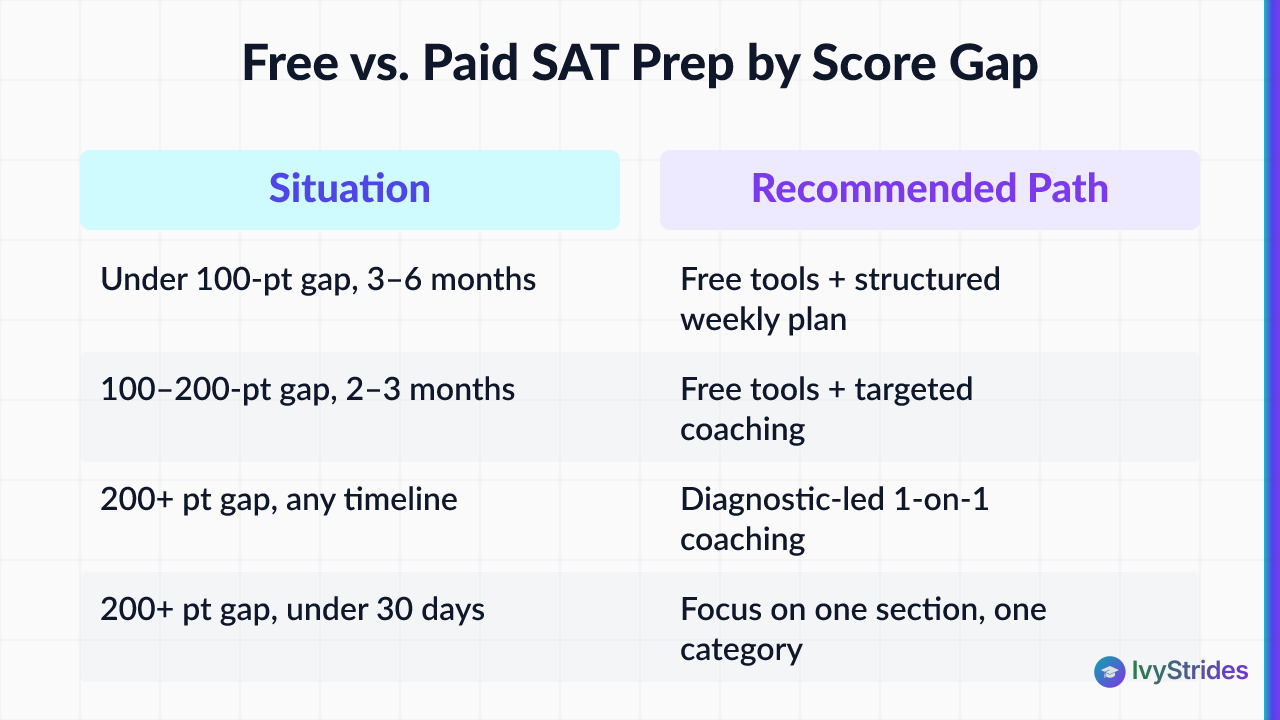
Whether you have one month or six months before your test date, the first step is the same: take a full-length official practice test in the Bluebook app and use that score to decide whether free tools alone will close your gap in time.
Once you have that diagnostic number, here's the framework:
Score Gap | Timeline Available | Recommended Path |
Under 100 points | 3 to 6 months | Free tools, structured weekly plan, biweekly full-length retests |
100 to 200 points | 2 to 3 months | Free tools plus targeted coaching on your weakest section |
200+ points | Any timeline | Diagnostic-led 1-on-1 coaching is the faster, more reliable path |
200+ points | Under 30 days | Realistic expectation reset: focus on one section, one question category set |
The commonly cited effort range is roughly 10 to 20 hours per week over 2 to 3 months for meaningful improvement. For a student starting at 1300 targeting 1500, that adds up to around 80 to 160 hours of focused practice. In our coaching, hours spent on categories you're already getting right produce almost no gain, which is why the diagnostic comes first.
Thirty days can work for small gaps. It rarely works for 200-point gaps as the primary prep window. If you're on that timeline, our 30-Day SAT Study Plan 2026 is the honest version of what to prioritize.
For self-directed students, log every mistake by category and reason using an sat mistake tracker. When you're ready to simulate real test conditions, our official SAT practice tests resource points you to Bluebook-format tests that count for calibration.
Is Paying for SAT Prep Worth It? An Honest Cost-Benefit Look
Paid SAT prep ranges from roughly $500 for self-paced courses, to around $2,000+ for live group programs, to about $5,000+ for intensive 1-on-1 coaching packages. That's a real number for a family, and it deserves an honest answer.
Here's the framing that matters. A score jump from 1300 to 1500 moves a student from roughly the top 25% of test-takers to roughly the top 3%. At schools like UPenn, the middle 50% SAT range sits around 1510 to 1570 (per the school's most recent Common Data Set; verify against the current year). A 1300 sits below that range. A 1500 sits inside it. That's not a small admissions distinction, and at selective schools it often changes the shape of the entire application read.
Two caveats have to sit next to that math.
First, test-optional policies vary by school and change year to year, so check each college's current policy before deciding whether a higher score is worth the additional prep investment. FairTest maintains a current tracker. At many test-optional schools, a strong submitted score still helps; a mediocre one doesn't. Don't confuse "test-optional" with "test-irrelevant."
Second, admissions outcomes depend on the full application. Essays, AP scores, extracurriculars, and recommendations all carry real weight at selective schools. A 1550 doesn't overcome a weak application. Our take on this tradeoff sits in does the SAT matter for college admission.
So is paid prep worth it? Honestly, in our coaching the variable that most predicts improvement isn't the sticker price. It's whether the plan starts with a real diagnostic, isolates errors by section using a specialist coach (SAT Math and SAT R&W are genuinely different skills), and uses spaced retesting to confirm the gains stick. If a paid program doesn't do those three things, the price tag isn't the point. If it does, the return usually justifies the investment for students with 150+ point gaps to selective-school ranges. That's the model behind our 1-on-1 SAT prep.
What Score Do You Actually Need? Benchmarks for Selective Schools
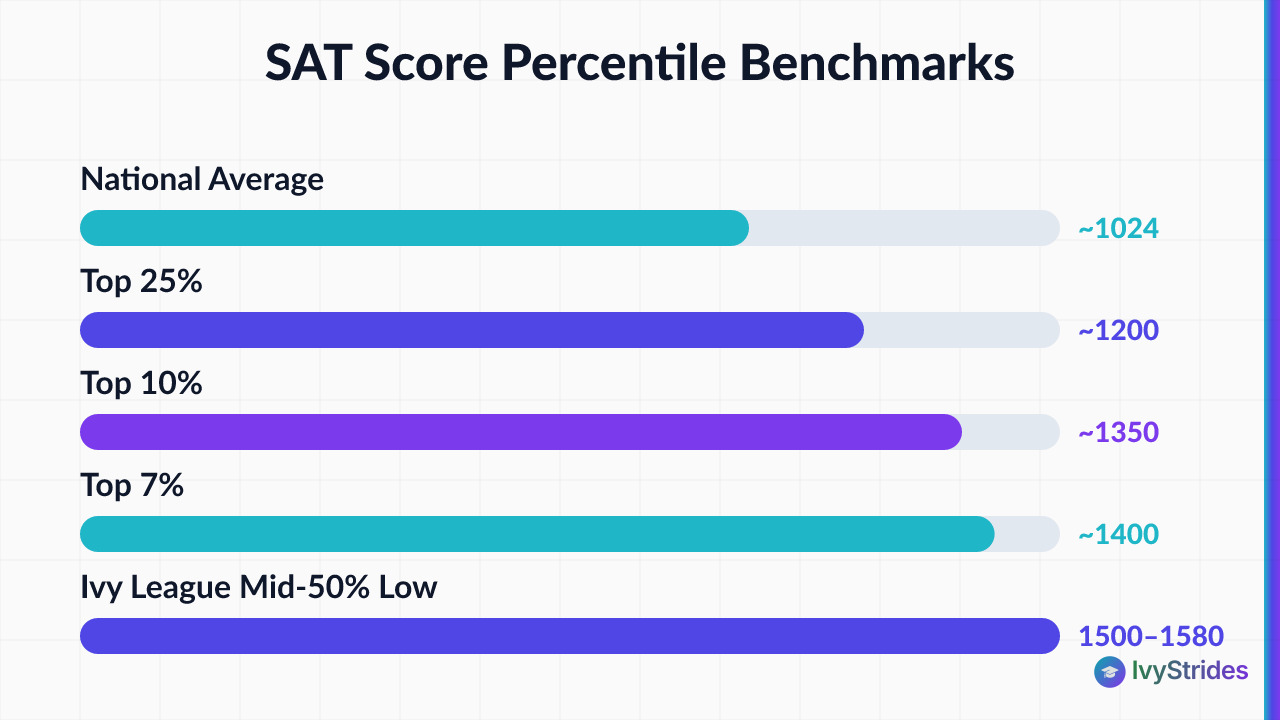
Set the target before you build the plan. Here's the reality of the scale.
The national average SAT score sits around 1024 per College Board data. Top 25% starts around 1200. Top 10% starts around 1350. Roughly 7% of test-takers reach 1400 or higher. Top 1% falls somewhere between 1450 and 1520 depending on the year (always check the current percentile table).
For Ivy League and peer schools, middle 50% SAT ranges typically fall between 1500 and 1580 (verify each school's Common Data Set for the current year). A 1400 sits below the 25th percentile at most of those schools, so it's generally not competitive at Harvard, Yale, Princeton, and similar. That doesn't mean don't apply. It means the rest of your application has to do more work.
A 1400 is a genuinely strong, competitive score at most excellent universities outside that top tier. A 1500 sits inside the competitive range for most highly selective schools, but it isn't a guarantee. Admissions still hinge on the full application. For a deeper look at what a specific high score signals, see is 1540 a good SAT score. For one school's specific numbers, our UPenn SAT Requirements 2026 walkthrough breaks it down.
How to Build a Free SAT Study Plan That Actually Works

If your gap and timeline say free prep can work, here's the plan that delivers gains. Skip the passive video-watching version.
Week 1: Diagnose. Take a full-length Bluebook practice test under real timed conditions. Score it. Identify which section (R&W or Math) has the larger gap. Inside that section, identify the two or three question categories accounting for the most missed questions. Ignore categories where you're already scoring above roughly 80%.
Weeks 2 through 4 (for a one-month plan): Attack the top three. Use your synced personalized practice queue to hammer only the categories from your diagnostic. Every session ends with logging errors in a mistake tracker: question type, reason (content gap, pacing, careless, comprehension), corrected approach. Our sat mistake tracker template makes this fast.
Every two weeks: Retest. A fresh full-length Bluebook test under timed conditions. Score movement tells you whether targeted work is translating.
For 3-to-6-month plans: roughly one full-length test per month, rotating through all weak categories before retesting. Add pacing drills in month two once content is solid.
What to study for SAT Math specifically: linear equations and systems, quadratic and exponential functions, and problem-solving with data account for the majority of Math section questions per College Board's published test specifications. Geometry and trigonometry appear at lower frequency. Prioritize accordingly. For calculator-active questions, get comfortable with the digital sat calculator inside Bluebook before test day, not the morning of.
Final week: cut new material entirely. Review your mistake tracker, retake sections you've already worked, and sleep. Our sat last minute tips piece covers the last-seven-days protocol.
Is a 1500 SAT Score in the Top 1%? Score Benchmarks Explained
Short answer: no, 1500 is not top 1%. A 1500 sits around the 96th to 98th percentile depending on the test year, which means roughly 2 to 4% of test-takers score at or above 1500. That's excellent, but it isn't top 1%.
Top 1% starts around 1450 to 1520 depending on the year. That range moves. Verify against the current College Board percentile table whenever you're calibrating a target.
Quick reference:
Score | Approximate Percentile | What It Means |
1200 | ~75th | Above average, top 25% |
1350 | ~90th | Top 10% of test-takers |
1400 | ~93rd | Around top 7% |
1500 | ~96th to 98th | Roughly top 2 to 4% |
1520+ | ~99th | Top 1% territory |
Percentiles shift slightly year to year, so treat these as calibration, not gospel. For a fuller breakdown of the SAT score scale, we've mapped the full percentile table. If you're evaluating whether a specific high score is competitive at your target list, is 1520 a good SAT score works through the answer school by school.
FAQ
Is the free official study partner platform really enough to score 1500 or higher?
It can be, if you're starting around 1350 to 1400 with 3 to 6 months to work. In our coaching, students who reach 1500+ using primarily free tools tend to be highly self-directed, use a mistake tracker religiously, and take a full-length Bluebook test every two to three weeks. Students starting below 1300 targeting 1500 typically need section-specialist coaching to close a 200+ point gap inside a standard prep timeline.
How long should I study for the SAT to get a 1500?
The commonly cited range is roughly 10 to 20 hours per week over 2 to 3 months for students with a meaningful gap. For a student starting at 1300 targeting 1500, that adds up to around 80 to 160 hours of focused practice. Starting with a full-length diagnostic is essential; it tells you whether those hours go to R&W, Math, or both, and which question types inside each section are costing you the most points.
Can you prepare for the SAT in one month?
One month is workable for gaps of 100 points or fewer, especially with a structured daily plan and at least two full-length Bluebook tests in that window. For gaps of roughly 150 to 200+ points, one month is unlikely to be enough. Two to three months is a more realistic minimum. If you only have 30 days, don't try to cover everything. Prioritize your weakest section and top three missed question categories.
Is a 1400 SAT score competitive for Ivy League schools?
A 1400 sits below the 25th percentile at most Ivy League schools, where middle 50% ranges typically fall between 1500 and 1580 (per each school's Common Data Set; verify against the current year). Admissions at those schools depend on the full application, including essays, AP scores, extracurriculars, and recommendations, so a 1400 doesn't disqualify a student. But it's not a competitive score at Harvard, Yale, or Princeton. At most strong universities outside that top tier, 1400 is a solid, competitive score. A strong SAT score is one part of a competitive application; your admissions essays and AP scores carry equal weight at selective schools.
Is getting a 1200 on the SAT hard?
A 1200 places a student around the top 25% of test-takers, which is above average but not exceptional. From the national average near 1024, reaching 1200 is a meaningful improvement of roughly 175 points. The official free platform is well-suited for this range because the primary limiters are content gaps that structured practice addresses. Pushing past 1200 toward 1350+ typically requires more targeted, section-specific work.
What should I study for SAT Math specifically?
The Digital SAT Math section weights algebra, advanced math (quadratics, polynomials, functions), and problem-solving with data heavily. Per College Board's published test specifications, linear equations and systems, quadratic and exponential functions, and data analysis account for the majority of Math questions. Geometry and trigonometry appear at lower frequency. Bluebook practice tests show you exactly which categories are costing you the most points.
Do test-optional schools still care about SAT scores?
Test-optional means you're not required to submit, but a strong submitted score still strengthens most applications. At many test-optional schools, submitted scores above the middle 50% range provide a modest admissions advantage. Policies vary by school and change year to year, so check FairTest and each school's current admissions page before deciding whether to submit. If you're also preparing for the PSAT/NMSQT with National Merit in mind, the same diagnostic-first approach applies, and strong SAT prep overlaps significantly with PSAT readiness.
---
Ready to Know Exactly What Your Score Needs?
Book a free 15-minute SAT strategy call. We'll look at your current score, your target, and your timeline, and give you a specific plan: free resources, coached prep, or a combination. No pressure, no pitch.


Comments