

What Is the Selection Index for National Merit, Explained: Everything You Need to Know in 2026
- prabaram1
- Jul 30
- 14 min read

The National Merit Selection Index is a score ranging from 48 to 228 that the National Merit Scholarship Corporation (NMSC) uses to decide which students qualify for recognition. It's calculated from your PSAT/NMSQT section scores using one formula: multiply your Reading and Writing score by 2, add your Math score, then divide the total by 10. A student who scores 680 on Reading and Writing and 680 on Math earns a Selection Index of (1360 + 680) / 10 = 204. State-specific Semifinalist cutoffs typically fall between roughly 207 and 223 depending on how competitive your state is.
Those numbers come from College Board PSAT/NMSQT documentation and NMSC's published Semifinalist guidance, both cited throughout this article. The harder question, and the one most PSAT score reports don't answer clearly, is whether your specific Selection Index actually clears your state's cutoff, and if it doesn't, which section you should target to close the gap. That's the map for the rest of this piece.
What Is the National Merit Selection Index? The Direct Answer
The Selection Index is the single qualifying number NMSC uses to filter roughly 1.5 million annual PSAT/NMSQT takers into the tiers of Commended Scholar, Semifinalist, and eventually Finalist. It runs from 48 (theoretical floor) to 228 (theoretical ceiling), and it's calculated only from the PSAT/NMSQT taken in 11th grade. Not the SAT. Not a 10th-grade PSAT. Only the junior-year sitting counts for the scholarship program.
The formula is fixed: (2 × Reading and Writing section score + Math section score) ÷ 10.
A concrete walkthrough. A student scores 700 R&W and 690 Math on the Digital PSAT/NMSQT. R&W doubled is 1,400. Add the 690 Math score: 2,090. Divide by 10: 209. That's the Selection Index. It appears directly on the official PSAT/NMSQT score report in the student's College Board account, so you don't need to compute it manually. But knowing the formula tells you something the score report doesn't: which section is worth prepping harder.
Here's the part most students miss. Because R&W is weighted double, every 10-point section-score gain in Reading and Writing lifts the Selection Index by 2 points, while every 10-point gain in Math lifts it by only 1 point. The Digital PSAT is adaptive, section-scored on a 160-760 scale per section, and administered each October, per the official College Board PSAT/NMSQT page. If you want to understand the underlying exam before you optimize for the index, start with our overview of Digital PSAT format and sections.
How the Selection Index Formula Works: Reading and Writing Counts Double
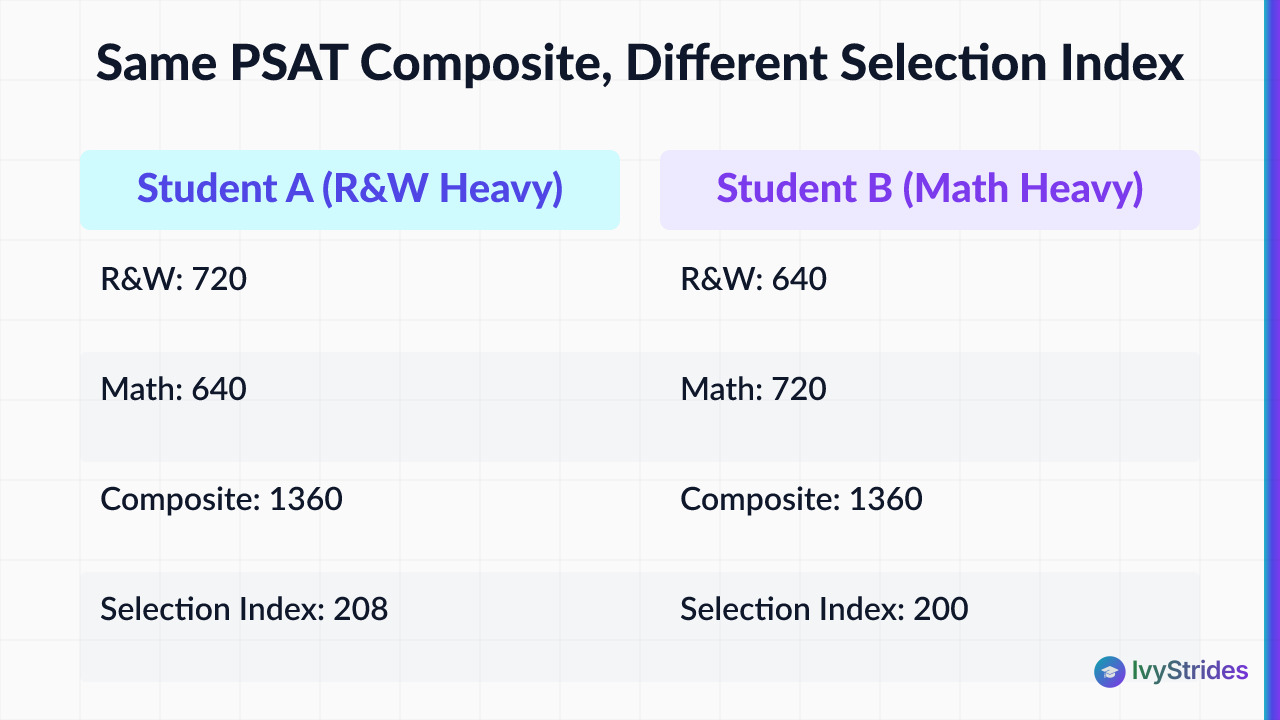
Because the Selection Index is built entirely from your PSAT/NMSQT section scores, understanding the Digital PSAT format and how each section is scored is the first step toward hitting your target index. Both R&W and Math run on a 160-760 scale. The composite (320-1520) is just the sum of the two, but NMSC ignores the composite. It cares only about the weighted index.
Two students, same composite, very different outcomes. Consider:
Student A: R&W 720, Math 640. Composite 1360. Selection Index = (1440 + 640) / 10 = 208.
Student B: R&W 640, Math 720. Composite 1360. Selection Index = (1280 + 720) / 10 = 200.
Same PSAT composite. Eight-point Selection Index gap. In roughly half the U.S. states, Student A clears the Semifinalist cutoff and Student B doesn't.
Section balance matters more than composite when National Merit is the goal. R&W is where the use lives. On the Digital PSAT R&W section, the four question domains are Information and Ideas, Craft and Structure, Expression of Ideas, and Standard English Conventions, per College Board's assessment framework. Two of those, Standard English Conventions and Expression of Ideas, tend to be the fastest to improve with targeted work, because they test rule-based grammar and rhetoric rather than open-ended comprehension.
Once you know your Selection Index and where it falls relative to your state's cutoff, your PSAT section scores become the clearest diagnostic you have for setting a realistic SAT target. If you're already thinking about that transition, see how to use your PSAT score to set an SAT goal. To pressure-test your current index with a full-length simulation, our PSAT practice tests library mirrors the adaptive digital format.
Your Selection Index vs. Your State Cutoff: Why the Same Score Qualifies in One State but Not Another
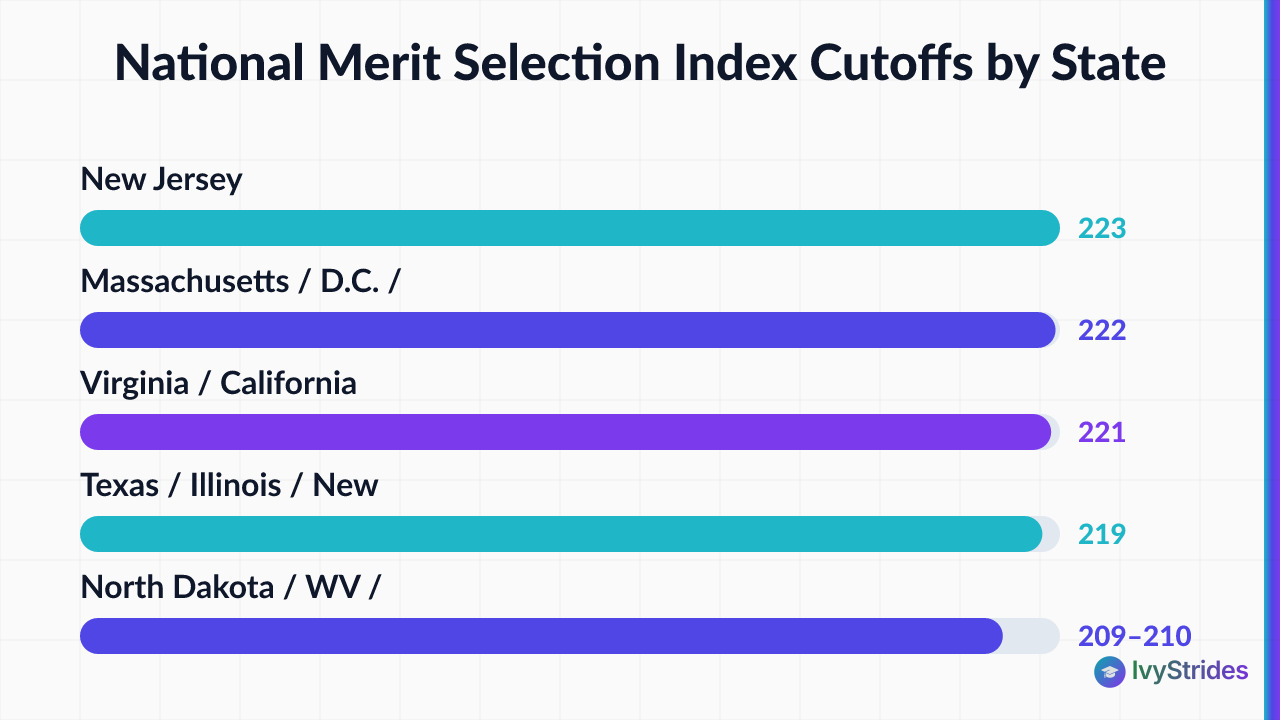
Here's the frustrating truth. NMSC does not set a single national Semifinalist cutoff. It sets more than 50 separate ones. Each state (plus D.C., U.S. territories, and boarding-school and international-school categories) gets a Semifinalist threshold calculated so that roughly the top 1 percent of that state's test-takers advance. High-scoring states get high cutoffs. Lower-scoring states get lower ones.
Approximate recent-cycle cutoffs, based on historical tracking from public sources:
State (representative sample) | Recent Selection Index cutoff |
New Jersey | 223 |
Massachusetts | 222 |
California | 221-222 |
Washington, D.C. | 222 |
Maryland | 222 |
Virginia | 221 |
Texas | 219 |
New York | 219-220 |
Florida | 217 |
Illinois | 219 |
Ohio | 215 |
North Dakota | 209-210 |
West Virginia | 209-210 |
Wyoming | 209-210 |
These are historical estimates. Cutoffs typically shift by 1 to 3 points year to year, and NMSC doesn't publish them in advance. Official cutoffs for a given testing year are only confirmed in September of the following year, when NMSC releases the Semifinalist list. That's a full 11 months after the October test. So if you took the PSAT in October 2025, your official state cutoff isn't confirmed until September 2026.
The Commended Scholar cutoff is different. It's a single national threshold, set by NMSC each year, that has hovered around 207 to 209 in recent cycles. It sits below almost every state's Semifinalist cutoff, which means students who score above the national Commended threshold but below their state's Semifinalist threshold receive Commended recognition, not Semifinalist status. Roughly 34,000 students earn Commended recognition annually, and about 16,000 are named Semifinalists.
If you're in a high-competition state, target a Selection Index of at least 222 to build a genuine buffer. In a mid-cutoff state, aim for around 218 to 220. In a lower-cutoff state, roughly 212 is a safer target than 210. The buffer matters because the cutoff may rise between the year you saw historical data and the year your class is scored.
For the broader context on how the whole program flows from PSAT to scholarship, see how does National Merit work. If you're wondering how the exam compares in difficulty to the SAT you'll eventually take, is the PSAT harder than the SAT walks through the honest answer.
Not Sure If Your PSAT Score Is Enough for National Merit in Your State?
In a free 15-minute strategy call, an IvyStrides coach will review your PSAT section scores, calculate your Selection Index, compare it to your state's historical cutoff, and tell you exactly which section to target for the biggest gain before October. Parents welcome on the call.
Commended, Semifinalist, Finalist: Which Tier Does Your Index Score Reach
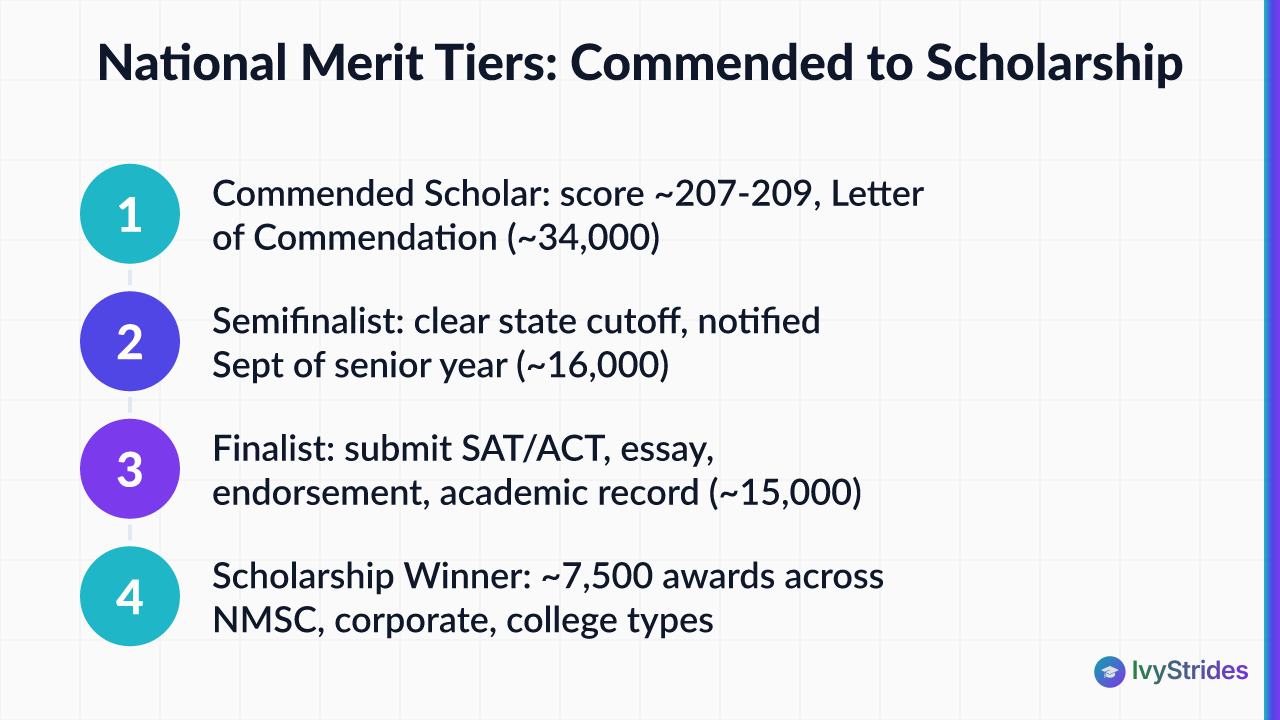
The Selection Index is just the entry point. The full National Merit process from Semifinalist to Finalist to scholarship winner involves several additional steps worth understanding before October of junior year.
Commended Scholar (roughly 34,000 students annually). You cleared the national Commended cutoff (typically around 207-209) but fell below your state's Semifinalist threshold. You receive a Letter of Commendation. You don't advance to the scholarship competition. It's still a real academic honor and worth listing on college applications, especially in an academic honors section, because it signals top-3-percent-nationally PSAT performance.
Semifinalist (roughly 16,000 students annually). Your Selection Index cleared your state's Semifinalist cutoff. You're notified through your high school in September of senior year. You now have the opportunity to advance to Finalist by submitting a full application package.
Finalist (roughly 15,000 students annually, out of the 16,000 Semifinalists). To confirm Finalist status, you must submit:
A confirming SAT or ACT score that NMSC converts to a Selection Index equivalent on the same 48-228 scale. NMSC publishes the exact confirming score threshold each cycle.
A personal essay on a prompt provided by NMSC.
A school endorsement from your principal or counselor.
Your academic record, showing consistent rigor and strong grades.
Approximately 7,500 scholarships are offered each competition cycle, per nationalmerit.org. That total breaks into three buckets: the NMSC-funded $2,500 one-time scholarship (awarded to about 2,500 Finalists), corporate-sponsored awards (often tied to a parent's employer or the student's intended major), and college-sponsored awards (given by universities to Finalists who list them as first choice).
A note on the college-sponsored track. Some universities offer substantial merit packages, including in some cases full or near-full tuition, to enrolled National Merit Finalists. These vary by institution and by year, and several schools have modified or eliminated their National Merit awards in recent cycles, so verify current terms directly with each university's financial aid office. Don't assume a scholarship you read about in an old forum post is still available.
A strong Selection Index combined with a rigorous AP course load signals academic readiness, making PSAT prep and AP prep complementary investments in the same admissions outcome. If you're building the AP side of that profile, our AP courses online are taught by per-subject specialists, one teacher per AP subject rather than a generalist covering everything. Sophomores curious about where they currently stand can start with what is a good PSAT score for a 10th grader.
Does a 1440 or 1470 PSAT Score Qualify for National Merit? Reading the Numbers Correctly
Short answer: it depends on the section split and the state. Here's the math for the three composites students ask about most.
1400 composite. A balanced 700 R&W / 700 Math yields a Selection Index of (1400 + 700) / 10 = 210. That clears the national Commended threshold in most cycles and would earn Semifinalist status in the lowest-cutoff states (roughly 209-211), but falls short of Semifinalist in virtually every mid- and high-competition state. A 1400 is a strong PSAT score in absolute terms but not typically a National Merit Semifinalist score.
1440 composite. Two very different Selection Indexes depending on section balance:
720 R&W / 720 Math (balanced): Selection Index = (1440 + 720) / 10 = 216. Qualifies in most states, though still shy of top-tier cutoffs like New Jersey's 223.
680 R&W / 760 Math (Math-heavy): Selection Index = (1360 + 760) / 10 = 212. Falls short in California, New Jersey, Massachusetts, Maryland, D.C., and Virginia.
Same composite. Different outcome. If you're a Math-strong student sitting at 1440 in a high-competition state, R&W is your use point.
1470 composite. A balanced 735/735 (rounded to nearest reported score) yields a Selection Index of (1470 + 735) / 10 = 220.5, which rounds depending on the exact section scores to 220 or 221. That's competitive in nearly every state, though in the tightest years the top states (NJ, MA, D.C.) can reach 222-223. A 1470 with a heavy R&W tilt (say 760 R&W / 710 Math) yields (1520 + 710) / 10 = 223, which clears every state cutoff on record.
The pattern is clear. R&W dominance is the fastest path to a top-tier Selection Index. Every 10 points on R&W is worth 2 index points; every 10 on Math is worth 1. For sophomores or juniors already thinking about their scaled score positioning, 1280 PSAT score and what it means contextualizes lower bands. SAT percentiles and score scale shows how these PSAT numbers project onto the SAT after junior year.
What Is a Good Selection Index Score? Percentiles and Realistic Targets by State
"Good" depends on what you're optimizing for. For National Merit, good means clears your state's Semifinalist cutoff with a buffer. For college admissions generally, good means top-decile PSAT, which is a lower bar.
Some anchor numbers. A top-1-percent PSAT composite nationally is approximately 1460 to 1480, per College Board's PSAT/NMSQT percentile tables published on the official PSAT/NMSQT scoring page. A 99th-percentile PSAT composite runs approximately 1510 to 1520. A Selection Index of around 215 corresponds roughly to a 1430-1450 composite, depending on section balance. A Selection Index of 220 typically requires a 1470-1490 composite range.
Practical targets by state tier:
Highest-competition states (NJ, MA, CA, MD, D.C., VA): aim for a Selection Index of roughly 222+ to comfortably clear the cutoff.
Mid-competition states (TX, NY, IL, FL, WA, GA, CT, PA): aim for around 218-220.
Lower-competition states (WY, ND, WV, MS, MT, SD, AK): aim for roughly 212-214 for a real buffer above the roughly 209-211 recent cutoff range.
The gap between "good for admissions" and "good for National Merit" is real. A Selection Index of 205 puts a student well above the 90th percentile nationally, which is genuinely strong for most college applications. But it doesn't reach the Commended threshold in most years, and it doesn't reach the Semifinalist threshold in any state. If National Merit is the target, use these state tiers, not raw percentiles, to set your goal. For students planning their SAT prep as an extension of PSAT prep, our SAT prep overview explains how the two efforts connect.
How to Improve Your Selection Index Score Before the October PSAT
Every prep plan we build for a National Merit target student starts with the same first step: a full-length diagnostic PSAT under real testing conditions. Without that baseline, you're guessing about which section domains are actually costing you points.
Students who fall just below their state's Semifinalist cutoff often find that the same diagnostic-driven approach used in SAT prep, targeting their weakest question types in R&W, closes the gap. Here's the use math, made concrete.
Suppose a student's diagnostic shows 690 R&W and 720 Math, for a Selection Index of (1380 + 720) / 10 = 210. Their state cutoff is projected around 218. They need 8 more index points. Two paths:
Path A (Math-focused): raise Math from 720 to 760. That's a 40-point section gain and roughly 4 index points. Not enough.
Path B (R&W-focused): raise R&W from 690 to 730. Also a 40-point section gain, but doubled it becomes 8 index points. Exactly enough.
Same amount of prep work. Twice the index yield. In our coaching with students targeting a Selection Index improvement of roughly 5 to 8 points, the most efficient path is typically 3 to 4 weeks of focused R&W work on the student's two weakest question categories, drawn from the four Digital PSAT R&W domains: Information and Ideas, Craft and Structure, Expression of Ideas, and Standard English Conventions. Standard English Conventions in particular tends to yield the fastest gains because the rules are finite and testable.
A second tactical point about the digital adaptive format. Module 1 of R&W sets the difficulty of Module 2. If a student underperforms in Module 1, they're routed to the easier Module 2, which caps the maximum section score in the low 600s regardless of Module 2 performance. This means the first 27 R&W questions are strategically more important than the last 27. Consistent Module 1 accuracy is what unlocks the higher-scoring second module.
Timeline matters. Students who begin structured PSAT prep in 10th grade have time for two or three full diagnostic-and-refinement cycles before the October junior-year sitting that counts. Students starting in the summer before junior year still have time for a focused 10-to-14-week plan, though the margin is tighter. Waiting until September of junior year to start prep almost never leaves enough runway.
For the diagnostic step itself, use our PSAT practice tests library, which mirrors the adaptive digital format and gives a Selection Index projection from the results. For section-specific tactics on the highest-use R&W skills, see how to improve SAT reading score; the underlying question types are shared with the PSAT R&W section. For students who want a section-specialist coach (R&W or Math, not both), our 1-on-1 SAT prep program pairs students with tutors specialized in the section they need most.
What Happens After You Get Your Selection Index Score
The timeline is longer than most families expect. Here's what to know before you're inside it.
December of junior year. PSAT/NMSQT scores are released to students through their College Board accounts, typically in mid-December after the October test. Your Selection Index is on the score report. This is the number that determines whether you're in contention.
September of senior year (roughly 11 months later). NMSC notifies high schools of Semifinalists. Your principal or counselor tells you. Approximately 16,000 students are named nationally. If you're a Semifinalist, you receive the Semifinalist packet with instructions and the Finalist application, per NMSC's Requirements and Instructions guidance.
October to early winter of senior year. Semifinalists submit Finalist confirmation materials:
1. Confirming SAT or ACT score. NMSC converts your SAT or ACT into a Selection Index equivalent on the same 48-228 scale. If your confirming score falls short, your Finalist status is at risk, so most Semifinalists take a real SAT or ACT sitting before the confirmation deadline. Plan for this in your fall-of-senior-year testing calendar.
2. Personal essay. Written on a prompt supplied by NMSC. It's separate from the Common App personal statement but benefits from the same drafting, revision, and voice-work discipline. If you're already working with our common app essay tutor on your college applications, the Finalist essay usually takes one focused revision cycle on top of that work.
3. School endorsement and academic record. Your school counselor submits a recommendation and transcript.
February of senior year. NMSC notifies Finalists. Approximately 15,000 students receive Finalist certificates.
March through mid-May of senior year. Scholarship winners are notified in three rounds: NMSC-funded $2,500 scholarships first, corporate-sponsored awards second, college-sponsored awards last (tied to the college the Finalist has indicated as first choice on the NMSC form by the March 1 deadline). Total scholarships offered in the 2027 competition cycle are approximately 7,590, per NMSC.
Two caveats worth stating plainly. Scholarship amounts and sponsor availability vary year to year, and college-sponsored awards specifically have been reduced or eliminated at several universities in recent cycles, so verify current offerings directly at nationalmerit.org and with each college's financial aid office. Also, test-optional admissions policies at colleges don't affect National Merit eligibility, because the program is administered independently by NMSC and requires a confirming SAT or ACT score regardless of any individual college's testing policy.
For more on how the whole program fits together beyond just the Selection Index, see how does National Merit work.
FAQ
Does a 1440 PSAT score qualify for National Merit?
It depends on how the 1440 is split between sections and which state you tested in. A 1440 with a 720 R&W / 720 Math split produces a Selection Index of 216, which qualifies as Semifinalist in most states. A 1440 with a 680 R&W / 760 Math split produces a Selection Index of 212, which typically falls short in high-competition states like California, New Jersey, Maryland, and Massachusetts. Check the most recent state cutoff data before assuming either way.
Is 1470 a good PSAT score for National Merit?
Yes, in nearly all cases. A 1470 PSAT composite typically produces a Selection Index in the 218 to 221 range depending on section balance, which qualifies for Semifinalist consideration in most states. In the most competitive states (NJ, MA, D.C., MD), where cutoffs can reach 222 to 223, a 1470 is competitive but not guaranteed. Maximizing the R&W portion of the score is the most efficient way to push the index higher, since R&W is weighted double.
What is the National Merit Commended Scholar cutoff, and is it worth aiming for?
The Commended Scholar cutoff is a single national threshold set by NMSC each year, typically around 207 to 209 in recent cycles. It recognizes approximately 34,000 students annually who score just below their state's Semifinalist cutoff. Commended recognition doesn't lead to scholarship competition, but it's a meaningful academic honor that strengthens college applications, particularly for students in high-competition states where Semifinalist status is out of reach.
How much is the National Merit Scholarship?
NMSC itself awards a one-time $2,500 scholarship to approximately 2,500 Finalists each year. Beyond that, corporate sponsors and colleges fund additional awards that can range from a few thousand dollars to substantial merit packages. Some universities offer significant tuition awards specifically to National Merit Finalists who enroll, though the terms vary by institution and have changed at several schools in recent years. The total number of scholarships offered in the 2027 competition is approximately 7,590, per NMSC. Verify current award details directly with each sponsor and college.
Can a student outside the United States qualify for National Merit?
Students must take the PSAT/NMSQT at a participating school in the United States or at a U.S.-affiliated school abroad. International students attending school in the U.S. are generally eligible if they meet the citizenship or intent-to-become-U.S.-citizen requirements NMSC publishes. Students attending school entirely outside the U.S. at a non-participating school aren't eligible for the program. Confirm eligibility directly with NMSC before assuming either way.
Why does the Selection Index cutoff change every year?
Cutoffs aren't fixed. NMSC sets them each year based on the actual score distribution of that year's test-takers, calibrated so roughly the top 1 percent in each state advances to Semifinalist. The shift to the Digital PSAT in 2023-24 also affected score distributions, and cutoffs have adjusted accordingly. Year-to-year changes of roughly 1 to 3 points are normal, which is why we recommend students target a buffer of at least 3 to 5 points above the most recent published cutoff for their state.
The Selection Index looks like arithmetic. In practice it's a strategic lever. The students who convert PSAT prep into National Merit recognition are the ones who see the 2x R&W weighting early, take a diagnostic in 10th or early 11th grade, and target the exact question domains their score report flags as weakest.
Ready to Build a PSAT Prep Plan Around Your Target Selection Index?
Book a free 15-minute call with an IvyStrides coach. We'll review your current PSAT scores, identify your highest-leverage section, and map out a realistic timeline to hit your state's National Merit cutoff before junior year. Parents welcome on the call.



Comments