

What PSAT Score Do You Need for National Merit, Explained: Everything You Need to Know in 2026
- prabaram1
- Jul 30
- 12 min read

To qualify as a National Merit Semifinalist, you need to hit your state's Selection Index cutoff, which historically ranges from about 208 to 223 on a 48-228 scale. In composite terms, that maps to roughly a 1400 to 1520 PSAT/NMSQT score, depending on your state. California, New Jersey, and Massachusetts sit at the high end (around 220-223). Wyoming, Montana, and North Dakota sit at the low end (around 208-212). Only your 11th-grade PSAT/NMSQT counts. A separate, nationally uniform Commended Scholar cutoff, typically around Selection Index 207-209, recognizes strong scorers just below the Semifinalist line.
These numbers come from historical data released by the National Merit Scholarship Corporation and cross-referenced against College Board's official PSAT/NMSQT documentation. One caveat: state cutoffs are set after scores are released each cycle, so the ranges above are historical, not locked-in future targets. The rest of this article shows you how to calculate your own Selection Index and decide whether a structured prep plan can close your gap before October.
The Short Answer: What Score Qualifies for National Merit in 2026
Here's the compressed version, the way we'd say it on a strategy call.
Semifinalist: Selection Index of roughly 208-223, depending on your state. That's approximately a composite score of 1400-1520.
Commended Scholar: Selection Index around 207-209 nationally (no state variation). Roughly the top 3-4% of PSAT/NMSQT takers, about 50,000 students per year.
Finalist: Advances from the Semifinalist pool (about 16,000 students annually) after a full application including a confirming SAT score. Approximately 15,000 Finalists are named each year.
About 1.4 million juniors take the PSAT/NMSQT annually. The top 1% in each state clear the Semifinalist bar. That state-level competition, not a single national number, is the variable most students miss when they set a target score. A 1450 that clears the cutoff in Ohio may leave you around 20 Selection Index points short in California.
For a broader benchmark on how PSAT composites map to percentiles, our guide to what is a good PSAT score covers the full distribution.
What Is the Selection Index and How Is It Calculated?
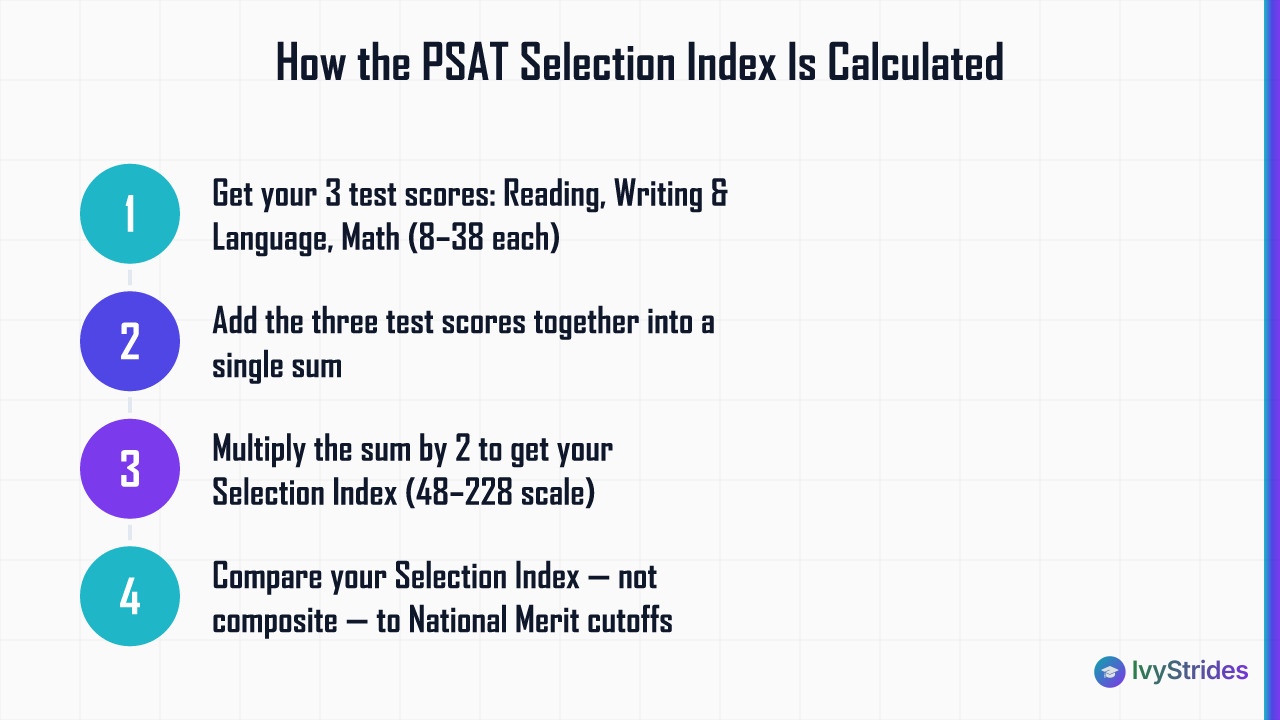
The Selection Index is the number the National Merit Scholarship Corporation (NMSC) actually uses. Your composite score (out of 1520) tells you how you did overall. The Selection Index translates that into the metric used for National Merit qualification.
Per College Board's official PSAT/NMSQT documentation, the Selection Index is calculated from three underlying test scores, each reported on an 8 to 38 scale: a Reading test score, a Writing and Language test score, and a Math test score. The formula:
Selection Index = 2 × (Reading test score + Writing and Language test score + Math test score)
That produces a number on a 48 to 228 scale. On the PSAT/NMSQT score report, your Reading and Writing section score (160-760) is derived from those separate Reading and Writing and Language test scores, and Math has its own 8-38 test score. NMSC weighs each of the three test scores equally, then doubles the sum.
Worked example. A student scores 34 on Reading, 33 on Writing and Language, and 36 on Math. Selection Index = 2 × (34 + 33 + 36) = 2 × 103 = 206. That student is just below a typical Commended Scholar threshold and clearly below every state's Semifinalist cutoff, even though the underlying composite (around 1420-1440) sounds strong.
Now change one variable. Same student, but Reading rises to 36 and Writing to 35. Selection Index = 2 × (36 + 35 + 36) = 214. Same student, roughly the same composite range, but now safely above the Commended line and within reach of Semifinalist status in mid-competition states.
This is the section-split problem most articles miss. Composite score alone hides which test scores are pulling their weight. Two students at a 1450 can have Selection Indexes 10+ points apart.
If you're new to the current digital adaptive format (two Reading and Writing modules, two Math modules, with the second module's difficulty determined by first-module performance), our breakdown of the PSAT format and sections walks through the two-stage structure and timing. If you're also weighing how the PSAT compares to the SAT, see the difference between SAT and PSAT.
Which PSAT Test Actually Qualifies for National Merit?
Only one: the PSAT/NMSQT, taken in 11th grade.
The PSAT 8/9 (for 8th and 9th graders) does not qualify. The PSAT 10 (a spring version for sophomores) does not qualify. Even the PSAT/NMSQT itself, if you take it as a sophomore, doesn't count for the program, though you'll get a real score report and useful diagnostic data.
The qualifying test is typically administered in October of junior year. The 2025 PSAT/NMSQT is the qualifying test for the 2027 National Merit program cycle (class of 2027). If a student misses their school's October administration, most schools offer a limited alternate date, but there's no "retake for a better National Merit score." One shot, junior year.
For sophomores planning ahead, taking the PSAT/NMSQT in 10th grade is a strong move. Your score won't be submitted to NMSC, but you get a genuine diagnostic that mirrors the junior-year format. Our overview of the differences between PSAT versions explains which sitting to prioritize at each grade level.
State-by-State Cutoffs: Why Your Location Changes Everything
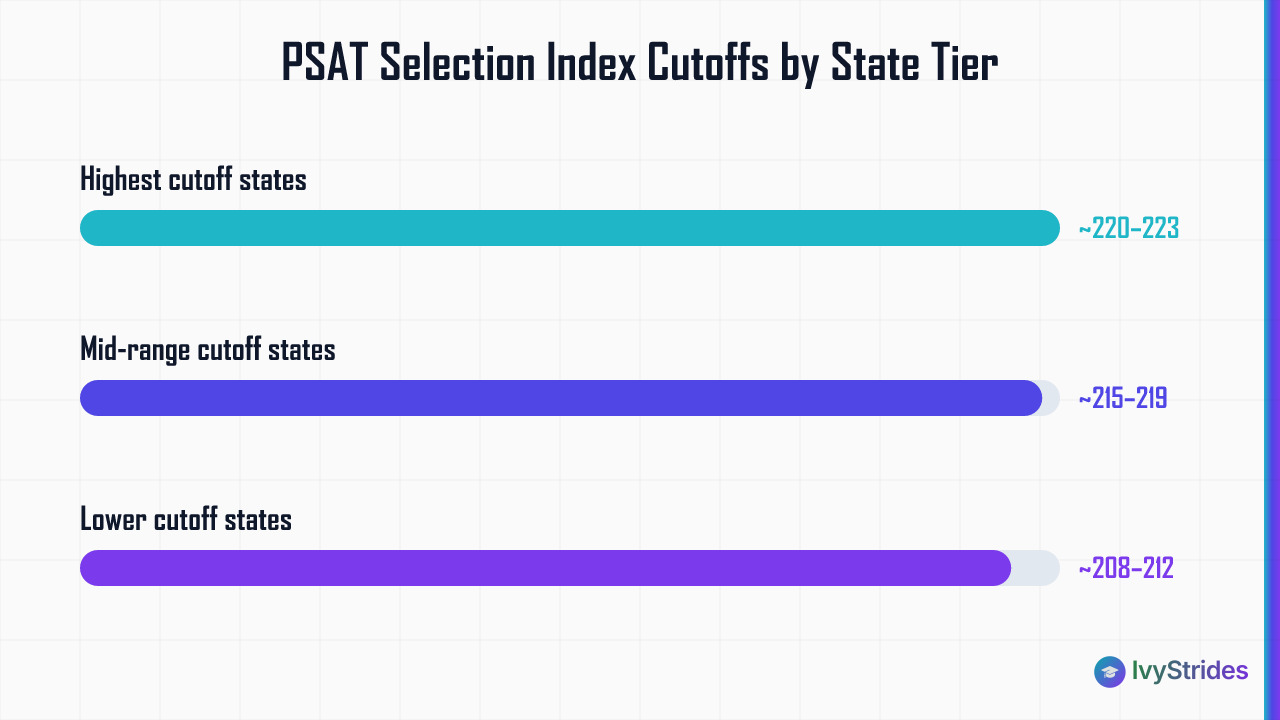
State cutoffs are set annually by NMSC after all scores are in. The ranges below come from historical NMSC data across recent cycles. Treat them as a planning benchmark, not a promise.
Highest cutoffs (Selection Index roughly 220-223): California, New Jersey, Massachusetts, Texas, New York, Connecticut, Virginia, Maryland, and Washington, D.C. If you live in one of these, a composite of about 1490+ is often the practical floor for Semifinalist status, and section balance matters enormously.
Mid-range cutoffs (Selection Index roughly 215-219): Florida, Ohio, Illinois, Pennsylvania, Georgia, North Carolina, Colorado, and Minnesota. A composite in the 1440-1480 range is typically competitive here.
Lower cutoffs (Selection Index roughly 208-212): Wyoming, Montana, North Dakota, South Dakota, West Virginia, Mississippi, and several other states with smaller test-taker pools. Composites in the 1400-1430 range can clear the bar.
Why the range? Semifinalist status is awarded to approximately the top 1% of scorers in each state. States with larger, more competitive test-taker pools push the top 1% higher. About 16,000 Semifinalists are named nationally each year, and NMSC distributes those seats proportionally by state.
Look up your state's most recent cutoff directly on the NMSC website after scores are released in September of your junior year. Anything you read before then, including this article, is a historical range.
If you're already scoring in a competitive band and want to pressure-test your readiness against full-length material, our PSAT practice tests library gives you the timed, adaptive-format runway.
Score Benchmarks: Does a 1400 Qualify, and What About 1350?
Straight answers, then the nuance.
A 1400 composite: Qualifies in some low-cutoff states, falls short in most high-cutoff states. A student with a balanced 700 R&W / 700 Math split lands at a Selection Index around 211-213, depending on the underlying test-score breakdown. That clears Semifinalist in Wyoming or Montana. It does not clear California or New Jersey. Section split matters: a 640 R&W / 760 Math at the same composite typically produces a different Selection Index than a balanced split, because the Reading and Writing and Language test scores each count independently in the formula.
A 1350 composite: Generally below Semifinalist range in every state, since the historical floor sits around Selection Index 208 (roughly a 1390-1400 composite depending on section split). A 1350 may sit close to or just below the Commended Scholar threshold in some cycles. Not a Semifinalist score, but not a wasted score either.
A 1470+ composite: Competitive in the majority of states. In lower-cutoff states, this is well above the line. In the highest-cutoff states (CA, NJ, MA), a 1470 with a good section split can clear; with a poor split, it may sit right on the bubble.
Top 1% nationally: Approximately 1480-1520 composite. Because Semifinalist status is scored state-by-state, a score at the national top 1% is competitive in nearly every state, though the highest-competition states may still require the upper end of that range.
Commended Scholar threshold: Selection Index of roughly 207-209 nationally. In composite terms, that's approximately 1390-1410, depending on section split. About 50,000 Commended Scholars are named each year, representing roughly the top 3-4% of all PSAT/NMSQT takers.
For sophomore benchmarking (where a 1230 or 1280 is a reasonable starting point, not a National Merit gap), see good PSAT scores for 10th graders. If you're wondering whether your current sophomore score is on track, our analysis of is 1280 a good PSAT score puts it in context.
The Three Recognition Tiers: Commended, Semifinalist, and Finalist
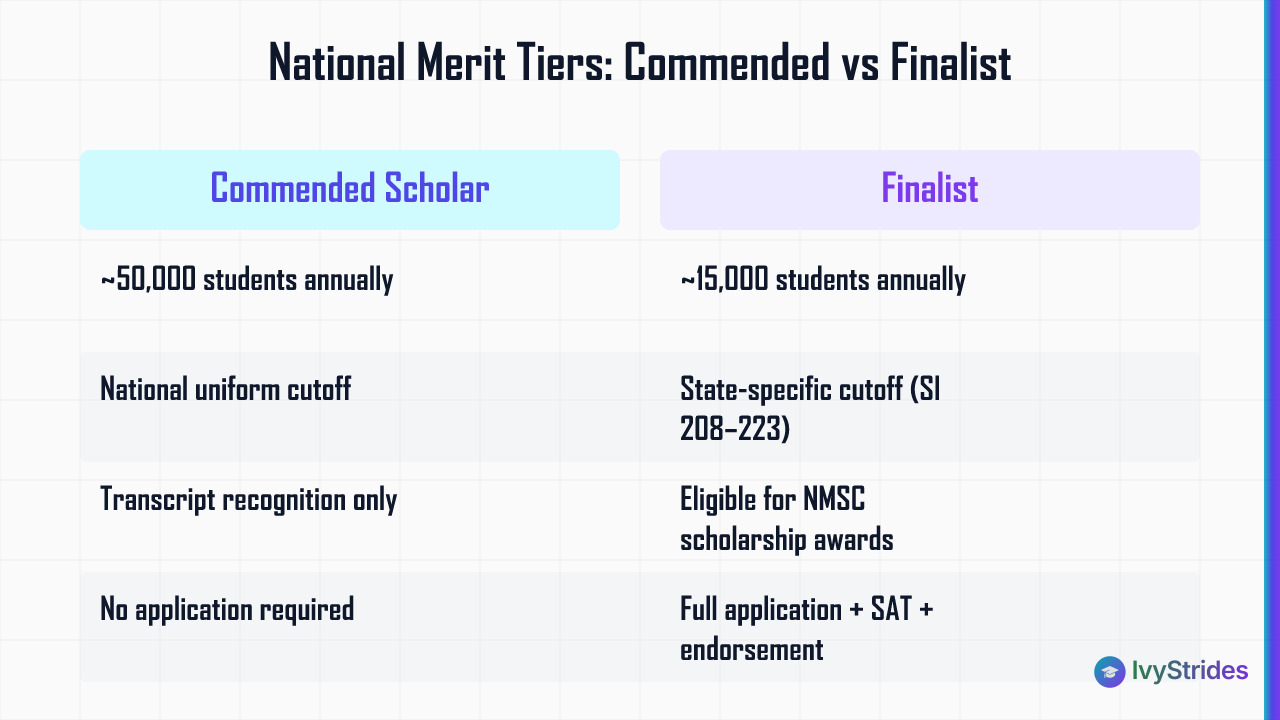
Each of the three National Merit tiers carries different score requirements and different practical value.
Commended Scholar (around 50,000 students annually). National uniform cutoff, no state variation. Recognition on transcripts and applications, and some colleges offer scholarship consideration to Commended Scholars, but the tier doesn't advance toward NMSC scholarship awards. It's a real credential, just a smaller one.
Semifinalist (around 16,000 students annually). State-specific cutoff (Selection Index 208-223). Semifinalists receive a certificate and are invited to apply for Finalist status. This is where the state-competition variable bites hardest.
Finalist (around 15,000 students annually). Roughly 94% of Semifinalists advance to Finalist after completing the application. Requirements include a confirming SAT score, a full application, an endorsement letter from a school official, and a strong academic record. NMSC doesn't publish a specific SAT cutoff for the confirming score, but the score must be consistent with the student's PSAT performance. In practice, most Semifinalists need an SAT score in roughly the 1400-1520 range to confirm.
Finalists compete for three types of awards. NMSC-sponsored scholarships are one-time awards (currently around $2,500). Corporate-sponsored scholarships come from employers of parents in participating companies. College-sponsored scholarships are where the money gets serious. Some universities, including the University of Alabama and the University of Oklahoma in recent years, have offered full-tuition or near-full-tuition awards to National Merit Finalists who enroll. Policies vary by institution and shift year to year, so verify current terms directly with each college before treating National Merit as a specific financial-aid strategy.
For a week-by-week prep approach targeting the Semifinalist range, see how to prep for National Merit.
What to Do If You Are Close to the Cutoff
This is the real question. You have a PSAT score, or a target, and you're within striking distance of your state's cutoff. Now what?
Here's the honest framework.
Step 1: Calculate your exact Selection Index gap. Pull out your PSAT score report (or a recent practice test). Identify your Reading, Writing and Language, and Math test scores on the 8-38 scale. Compute your current Selection Index. Subtract from your state's historical cutoff. That number, the gap in Selection Index points, is what you're actually working to close. A 10-point gap is different from a 25-point gap.
Step 2: Diagnose the weakest section. The test score furthest from 38 is usually where the largest gains sit, because ceiling effects make the top of each score harder to move. A student at Reading 34 / Writing 33 / Math 36 has more Selection Index use in Writing and Reading than in Math, because Math is closer to the top of the scale.
Step 3: Attack question types, not sections in general. In our coaching with students in the 1350-1430 composite range, a diagnostic-driven plan targeting the weaker section typically yields roughly 20-40 Selection Index points for students completing an 8-12 week program. The gains come from identifying the specific question types costing repeated points (transition-word logic, quantitative reasoning with algebraic setup, inference questions on paired passages), not from generic extra practice.
Step 4: Retest on a spaced schedule. Full-length timed practice every 2-3 weeks, with error analysis between sessions. In our coaching, students who plateau in weeks 4-6 are usually repeating the same 2-3 error types across every practice test, which is what structured error analysis surfaces.
Section-specialist coaching means one coach for Reading and Writing, a different coach for Math, each a specialist rather than a generalist covering both. That model matters most for students within 15-25 Selection Index points of their state's cutoff, where the last few points come from targeted question-type work, not general practice.
To see how your Selection Index sits relative to all test-takers, it helps to see how PSAT composite scores map to percentiles, which we cover in detail in our guide to what is a good PSAT score.
Once you know your Selection Index and whether you are within range of your state's cutoff, the natural next step is translating that PSAT score into a concrete SAT goal for junior year, which our playbook on how to use your PSAT score to set an SAT goal walks through step by step.
Students who reach Semifinalist range rarely do so by accident. Our guide on how early you should start PSAT prep shows the grade-by-grade preparation window that gives students the most runway. If your diagnostic puts you within 10-15 Selection Index points of your state's cutoff, a structured plan focused on your weakest section can close that gap; see our complete playbook on how to prep for National Merit for the full week-by-week approach.
Not Sure If Your Score Can Reach Your State's Cutoff?
Book a free 15-minute strategy call. We'll review your current PSAT score or diagnostic, calculate your Selection Index, and tell you exactly how many points you need and whether a structured prep plan can realistically get you there before October. Parents and students both welcome on the call.
Is Free PSAT Prep Enough to Reach National Merit Range?
Honest answer, and it depends on where you're starting.
If you're already scoring 1380+ and need targeted polish on specific question types, the free official PSAT practice from College Board is genuinely sufficient for many students. Take timed full-length practice tests, review every error, and rebuild your weak question types. That's a legitimate path.
If you're more than 30-40 Selection Index points below your state's cutoff, the math changes. Unstructured self-study has a documented failure pattern: students practice what they're already good at and avoid what feels hard, which is exactly the opposite of what closes a score gap. In our coaching, students who arrive with a clear diagnostic and a targeted weakness list make faster progress than students who repeatedly retake practice tests without structured error analysis. The gap between "practicing" and "practicing the right things" is where a section-specialist coach earns their keep.
Two honest notes. First, some students at any starting score simply learn better with accountability and a live coach; that's a personal-fit question, not a score-band question. Second, families spending in the $2,000-$6,000 range on PSAT and SAT prep should treat it as a considered decision. If you're weighing self-study against structured coaching, our full breakdown at is free PSAT prep enough to make National Merit walks through the tradeoffs honestly.
If you've concluded you need one-on-one support, our PSAT 1-on-1 prep program pairs each student with a section-specialist coach for Reading and Writing and a separate specialist for Math, working from a diagnostic-first plan.
FAQ
Does a 1400 PSAT score qualify for National Merit?
A 1400 composite may qualify in lower-competition states where the Selection Index cutoff is around 208-212, but it typically falls short in high-competition states like California, New Jersey, or Massachusetts, where cutoffs sit near 220-223. Whether a 1400 qualifies also depends on the section split, because the Selection Index weights the Reading, Writing and Language, and Math test scores equally. A balanced Reading 34 / Writing 34 / Math 34 profile lands in a different position than a 30 / 30 / 38 profile, even at the same composite.
Is a 1350 PSAT score good enough for National Merit?
A 1350 composite is generally below the Semifinalist cutoff in all states, which historically start around Selection Index 208 (roughly a 1390-1400 composite, depending on section split). A 1350 may sit close to or just below the Commended Scholar threshold in some cycles, which recognizes roughly the top 3-4% of PSAT takers nationally. For a junior aiming at Semifinalist status, a 1350 represents a meaningful but closeable gap; in our coaching with students in this band, an 8-12 week diagnostic-driven program typically yields roughly 20-40 Selection Index points for students who complete it.
What PSAT score puts you in the top 1% nationally?
A PSAT/NMSQT composite of approximately 1480-1520 places a student in roughly the top 1% of all test-takers nationally. Because Semifinalist status is awarded to about the top 1% of students in each state, a score in this range is competitive in most states. The highest-competition states may still require a composite at or near 1510-1520 with a balanced section split to clear the Semifinalist cutoff.
Do I need a matching SAT score to confirm National Merit status?
Yes. To advance from Semifinalist to Finalist, you must submit a Finalist application that includes a confirming SAT score. NMSC doesn't publish a specific SAT cutoff, but the score must be consistent with your PSAT performance. In practice, most Semifinalists need an SAT in roughly the 1400-1520 range to confirm. Plan to take the SAT in the fall or spring of junior year so you have a confirming score ready by the application deadline.
Can a sophomore's PSAT score count toward National Merit?
No. Only the PSAT/NMSQT taken in 11th grade qualifies for National Merit. A sophomore who takes the PSAT/NMSQT gets a real score report and useful diagnostic data for planning, but that score isn't submitted to NMSC. That makes the junior-year October PSAT the single most important PSAT sitting for National Merit purposes, which is why we recommend sophomores use their PSAT/NMSQT (or PSAT 10) primarily as a diagnostic to shape 10th and 11th-grade prep.
How good is a 1230 PSAT score?
A 1230 is above the national average and represents solid preparation, particularly for a sophomore. It sits well below the National Merit Semifinalist range in every state, which typically requires a composite of approximately 1400 or higher. For a junior, a 1230 would land outside both the Commended Scholar and Semifinalist thresholds. The constructive read: a 1230 gives you a clear diagnostic baseline, and with a targeted 8-12 week prep plan focused on your weaker section, meaningful score improvement is realistic before the next PSAT sitting.
---
National Merit qualification comes down to one number, your state's Selection Index cutoff, and one variable most students overlook, the balance of your Reading, Writing and Language, and Math test scores. Know your gap, work the right question types, and an 8-12 week program can move the needle. If you're not sure where you stand, that's what a strategy call is for.
Our section-specialist coaches work with students at every score band. You can review their credentials on the tutors page. To learn more about how we build diagnostic-first plans, read about IvyStrides.
Ready to Build a Plan Around Your State's National Merit Cutoff?
Our PSAT section-specialist coaches start every student with a full diagnostic, calculate the exact Selection Index gap, and build a targeted prep plan around the question types costing the most points. Students and parents: book your free 15-minute call and leave with a clear number to aim for.



Comments